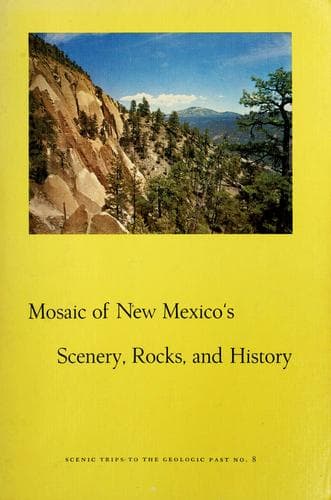
Mosaic of New Mexico's Scenery, Rocks, and History
History
Mosaic of New Mexico's Scenery, Rocks, and History
Geology -- New Mexico; New Mexico -- Description and travel; New Mexico -- History
_Disinherited_, that is the word that best describes contemporary New
Mexico culture. A stronger race came and took away the inheritance of
the Indian, though there did result a blood mixture. Only in superficial
matters did the Spanish adopt any of the Indian ways. The Spanish, too,
succumbed to a stronger people and have been denied the privilege
commonly accorded to conquered peoples, that of mixing their blood with
that of the conquerors. One finds today in New Mexico three distinct
people—Indian, Spanish, and Anglo-American—as sharply contrasted as the
strands in a Navajo blanket. There is pure red alongside white, and only
rarely do the colors blend into pinks or grays. This is why we must say
that New Mexico is a mosaic, not a synthesis, of many elements, clearly
defined.
Across the span of time, great men, people, and ideas have molded New
Mexico and Southwest history. Indian, Spanish, American—vital forces
that are today working toward a genuinely unique culture in New Mexico.
The modern world may well give to the Southwest the idea or catalyst
that will blend these elements into a single force. Science, techniques,
ideas are things of the present and are for the present to assess and
synthesize. The Indian gods of air, earth, and sky and the white man’s
gods of morality and science do not differ a great deal in their
aspirations for their chosen people, and perhaps they will decree a
splendid and unique synthesis from the cultural mosaic. Through
understanding comes knowledge; from knowledge, creation.
The Exotic Plants of New Mexico
_by_ Ross Calvin
The problem of discussing plant life becomes complicated, for some of
those arriving in New Mexico may be compound microscope botanists, some
collectors, others pathologists, still others geneticists. Some will be
chemists or mathematicians, some others untrained in the ways of growing
things and mainly interested in seeing while they tour. But one thing is
fairly certain—most visitors will come from a distance, so it may be
useful to invite them to observe what they can readily see on the way
hither, which will be a relatively painless method of amassing some
information.
Yet the method of arrival itself suggests choices, options, and
exercises in probability. Do visitors come in covered wagons, or in jet
planes; by bus, car, train, or some other way? The most convenient way,
doubtless, is by plane traveling six hundred miles an hour at a height
of some thirty thousand feet; but the most rewarding way is by saddle or
on foot as the early collectors came.
Public-domain text, read in full here on John Shaqi.
Reviews
Reviews
No reviews yet
Be the first to share your thoughts on this work.
Join the Discussion
Join the discussion
Sign in to leave a comment or review.
Sign InorCreate an account