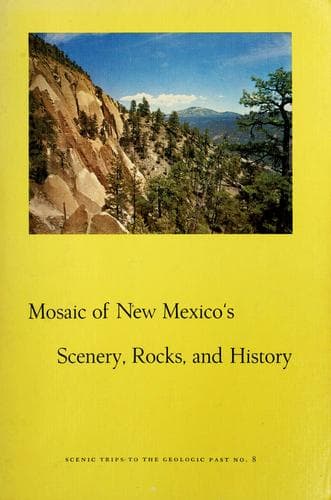
Mosaic of New Mexico's Scenery, Rocks, and History
History
Mosaic of New Mexico's Scenery, Rocks, and History
Geology -- New Mexico; New Mexico -- Description and travel; New Mexico -- History
Since one cannot know his own country well if he knows no other, a
visitor from the east arriving at an altitude of five miles will
probably be more conscious than others of drastic changes in the
landscape when he first looks down on New Mexico. Instead of the
universal green of the east, he will note the earth as an unaccustomed
tawny, reddish brown expanse, and this will be its common color through
most months of the year. He will note the absence of rivers, but the
presence of mountains which generally ring the horizon. He will wonder,
after traversing the border counties at the western edge of the Great
Plains, at the infrequency of plowlands, and will promptly conclude that
New Mexico is one vast, bare desert—an impression that will be corrected
rapidly when he visits the dark National Forests where the slim, crowded
spruces and firs tower skyward.
The visitor from El Paso, as the Chihuahua desert (the name is fairly
deserved) slides backward underneath him, will be amazed at the
serpentine stripe of vivid verdure below, all completely leveled, and
all marked off by geometrical lines and tightly bordered by pale hills
where the vegetation is reduced to tiny dots not tall enough to cast a
shadow. Still proceeding north, he will presently be above a ninety-mile
stretch where the vegetation is so skimpy and the river so closely boxed
in by desolate hills that Spanish explorers bestowed on it the sinister
name _Jornada del Muerto_—Dead Man’s Journey, which is self-explanatory.
But on the other hand, a visitor descending into New Mexico from the
northland in wintertime above this same Rio Grande will traverse a
featureless jumble of peaks on which the black coniferous forest no
longer shows as black at all but, snow-encased, gleams as white as the
naked snowfields themselves. And he will find incredible the immense
range of climate spanned in a flight only an hour long.
The jet traveler approaching from the west beholds the greatest, most
spectacular panorama of all, the true wasteland of the desert, with vast
blocks uplifted from out of earth’s crust, plateaus dissected by giant
empty canyons whose walls are seared to utter nudity by ages of the most
intense sunshine on our continent. Here the architecture of nature is
all designed on a gigantic scale, and the climate exhibits influences of
a mighty ocean, of towering mountain chains, and the range of wandering
planetary winds which created the desert. From the altitude of a
cruising jet, the distances, the speed, the color, and the light are
indescribably exhilarating.
Since the traveler arriving from any direction can see for
identification only a few species, it will suffice to point out only two
of the harbingers of eastern New Mexico, both of which are dominant on
that area of the Great Plains: the blue grama grass, which in fall and
winter bears the graceful sickle-shaped head, and the small _Yucca
glauca_ which cannot be mistaken for anything else.
Public-domain text, read in full here on John Shaqi.
Reviews
Reviews
No reviews yet
Be the first to share your thoughts on this work.
Join the Discussion
Join the discussion
Sign in to leave a comment or review.
Sign InorCreate an account