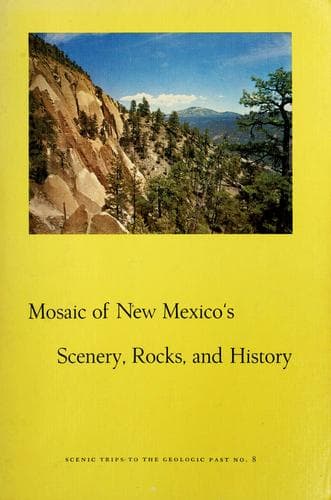
Mosaic of New Mexico's Scenery, Rocks, and History
History
Mosaic of New Mexico's Scenery, Rocks, and History
Geology -- New Mexico; New Mexico -- Description and travel; New Mexico -- History
Along the northern line, the visitor should look for the somber, almost
black, forest of spruce and fir with its white patches of aspen on the
10,000-foot slopes. Descending farther southward, even a casual observer
will note that these species give way first to the yellow pines, then to
the junipers (“cedars”) and dwarf pines or piñons. The visitor arriving
from the south will find most conspicuous of all the olive-green
creosote bush in its summer-winter foliage, next, the omnipresent
mesquite (_Prosopis_), then the various _Opuntia_ cacti (chollas and
prickly pears), and the yuccas.
As he comes in from Arizona, the splendid saguaros will beckon him
toward the gateway of New Mexico, but they will nowhere enter it
themselves. The vase-shaped body of the ocotillo consisting of
unbranching, ten-foot wands should be recognized at a glance, as
likewise should the various yuccas and agaves. And in early springtime,
a low tree with a rounded mass of golden bloom will joyously proclaim
its identity as a paloverde.
The desert plants thus enumerated can be recognized along various
stretches of U.S. 66 as one holds his speed at a conservative ninety or,
even better, at a conservative sixty.
The amateur scientist will need to do some homework before he learns
much systematic botany or plant physiology. It takes considerable study
to comprehend the slow, age-long process which has resulted in the
evolution of all this grotesque vegetation: the interaction of extreme
aridity, high temperature, low humidity, high evaporation, infrequent
precipitation, the hostility of numerous chemical solutions, and the
natural rapacity of the animal population. Each plant must have an
adaptation of its own, from the tiny winter annual, which must race
through its course from a tender rosette to ripened seed before the
searing sunshine arrives, on up through the series to the stoic saguaro,
which seems able to scorn nature’s enmity.
Public-domain text, read in full here on John Shaqi.
Reviews
Reviews
No reviews yet
Be the first to share your thoughts on this work.
Join the Discussion
Join the discussion
Sign in to leave a comment or review.
Sign InorCreate an account