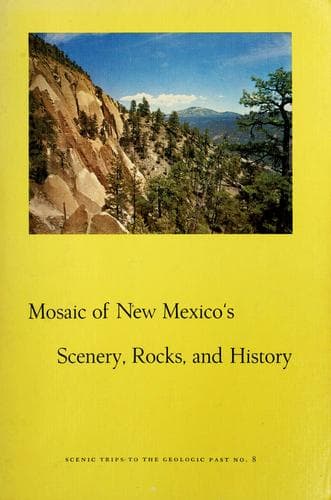
Mosaic of New Mexico's Scenery, Rocks, and History
History
Mosaic of New Mexico's Scenery, Rocks, and History
Geology -- New Mexico; New Mexico -- Description and travel; New Mexico -- History
Everyone inquires about the century plant’s life expectancy. An
insurance man might make an inference from the name. The plant is a big
compact cluster or rosette of rigid, upward-pointing, spadelike leaves,
each four or five inches in width and each tipped with a vicious, stout
thorn. Year after year the plant just sits there by a boulder,
unnoticed. I question whether anything alive on the desert has a better
life expectancy. As far as my observations go, it has no diseases. It is
invincible to drouth. Freezing does not harm it, and fire cannot burn
it—although a yucca even when green will flame up like a torch. No
hungry old cow can crop it, and no rodent gnaws it, at least not enough
to do harm. And since the Indians have gone on reservations, no human
uses it. So it stays there.
In fact, nothing less than a caterpillar can leave a dent on it—not, of
course, the caterpillar that eats young tomato plants, but the
Caterpillar that pulls heavy road machinery. The plant just does not die
before maturity, it would seem. A remarkable organism, indeed! But after
many, many years, depending on the amount of moisture it receives, it
makes up its mind to flower. In one tremendous effort, it shoots up a
twelve-foot flower stalk at the rate of several inches a day. The
blossoming is a final, dramatic, beautiful gesture, for by the time the
flowers have withered, the great tenacious plant has turned to a ghastly
purple and is dead.
On the high slopes where the last yuccas end and only a few junipers
remain in the race for survival, the yellow pines come in to mark off
what is called the Transition Zone. The pines need no description, no
printed promotion. The traveler, any traveler, can appreciate them
although he might not be stirred to the slightest interest by the lovely
yuccas. Since the beginning of time, the pines, fragrant, cheerful,
companionable, have been man’s best friend. Among the ponderosa pines
takes place most of the hunting, most of the camping, much of the
picnicking. There is no danger that the tourist will overlook the pine
belt and the pines for they are probably the most numerous tree in New
Mexico.
[Illustration: Piñon needles]
Above them, the classifications are less clearly defined and ecologists
are less inclined to agree on zonation. The Canadian Zone, if we settle
on that name, occurs only in small areas on the map, and most of them
north of Santa Fe. These are high ridges and island peaks that tower
high enough to tempt the Engelmann spruces. Yet some of these islands
occur as far south as the Mogollon Mountains and thus bring Canadian
Zone scenes almost to the Mexican border. For hardy ecologists who want
to explore high ridges and horns of bare stone which rise as clean as a
hound’s tooth clear up into the Arctic-alpine Zone, it is necessary to
enter Colorado.
Public-domain text, read in full here on John Shaqi.
Reviews
Reviews
No reviews yet
Be the first to share your thoughts on this work.
Join the Discussion
Join the discussion
Sign in to leave a comment or review.
Sign InorCreate an account