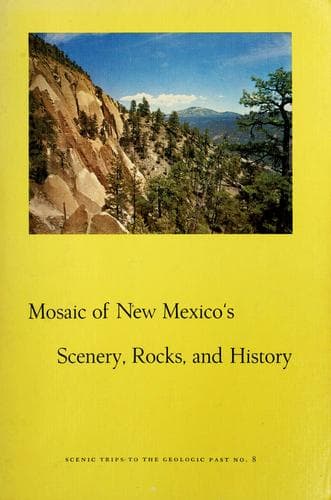
Mosaic of New Mexico's Scenery, Rocks, and History
History
Mosaic of New Mexico's Scenery, Rocks, and History
Geology -- New Mexico; New Mexico -- Description and travel; New Mexico -- History
Engelmann spruce forests may be associated with the 10,000-foot level.
The blue spruce is very similar, perhaps only a subspecies, but it comes
in a little lower. The Engelmann makes a dense forest hardly allowing
invaders, but the blue is more tolerant, less austere. It loves the
water and is the natural companion of chill, cascading trout streams.
Though fond of shadow, it seems to grow equally well where the narrow
canyons widen and admit the sunshine upon the tiny meadows of lush
grass, cranesbill, velvety red cinquefoils, lupines, and yellow
columbines. And when one of these miniature openings is fringed with
spruces whose pointed tips rise sharp against a curtain of azure with
its white cumulus clouds, there you have the loveliest vista in the
mountains.
OUR VISIBLE IMPACT ON THE PLANT LIFE
Though nature lovers usually find the life zones more fascinating than
any other aspect of plants in the mountains, there is one other much
more important. It is the misuse, injury, and destruction of native
plant life. Because scientists are generally alert to the conservation
of what is useful and beautiful in natural resources, I venture to bring
up the matter here.
A useful case history is provided by Silver City, New Mexico. It was
founded in the early seventies as a silver camp, which would fairly
guarantee a certain amount of reckless haste and rowdy carelessness.
Point two was its location on a foothill watershed only twenty-seven
square miles in area. Point three was an extreme concentration of
livestock near the town. Point four was the fact that the annual
rainfall was crowded mainly into July, August, and a part of September.
Mines are naturally users of timber. Obviously, shafts and tunnels have
to be timbered. More than that, little smelters nestled back among the
hills were also hungry for wood. And since coal was expensive and hard
to get, most of the adobe cottages were heated many years by juniper,
oak, and piñon firewood. All these matters were naturally, if not
actually, inevitable under the circumstances.
Public-domain text, read in full here on John Shaqi.
Reviews
Reviews
No reviews yet
Be the first to share your thoughts on this work.
Join the Discussion
Join the discussion
Sign in to leave a comment or review.
Sign InorCreate an account