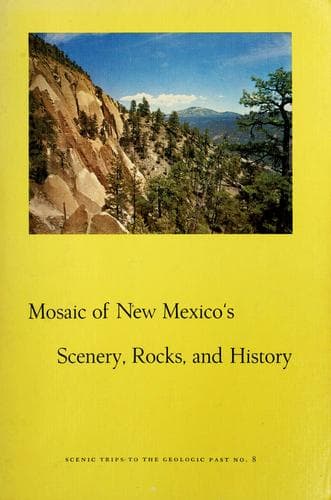
Mosaic of New Mexico's Scenery, Rocks, and History
History
Mosaic of New Mexico's Scenery, Rocks, and History
Geology -- New Mexico; New Mexico -- Description and travel; New Mexico -- History
The massive ore wagons and freight wagons had to be drawn by four- to
ten-horse teams—and the horses kept on eating. Then because it was also
a ranching country, each cowboy had to keep a _remuda_ of saddle
horses—and they ate too. Also, the few cows that provided milk for the
children grazed hungrily over the stony slopes. Most of all, the range
cattle, which had no provender at all except that which the competitive,
half-starved steers could provide for themselves, overgrazed every
square foot of pasturage down to the bare soil. The government’s
open-range policy made overgrazing inevitable because no ranchman could
protect his pasturage since it was all unfenced. The cow that got there
first got the grass. That passed as land management, which proves that
some statesmen then were about as wise as some of the Wizards of
Washington now. But the advent of fences caused the cutting of millions
of fence posts where none should have been cut.
[Illustration: Elk]
When the grass went, its roots went, and when its roots went, there was
nothing to hold the soil, and then it, too, started to go. And go it
did. A deep hole formed in Main Street, as it is still called on the
Silver City town plat. The best explanation I can find of that hole is
that earth was taken out of it to form adobe bricks for the walls of
houses and corrals (that clay did make good adobe!). Meanwhile, the
woodhaulers’ wagons had greedily carted away the trees from each little
canyon, while the narrow steel tires cut deep ruts which formed two deep
gullies at the first heavy rain. Then the parallel gullies proceeded to
wash out deeper and create a middle ridge or high center on which axles
got stuck. Since there was nobody responsible for making a new road,
there was no choice except to move over and form another track and use
it until in turn it became unusable. (By this simple kind of
destruction, the old Santa Fe Trail, it is said, reached a width of a
hundred feet.)
But the water descending the slope kept increasing its destructive
velocity as the denuded ground approached the bareness of a tin roof.
Villagers observed that the hole in their Main Street was becoming a
waterfall after each rain, and that the ruin was passing into a big-time
operation. The town built a dam to restrain the floods. It washed out in
the first one. Soon Main Street followed it down the drain, which by
this time was already a hideous gash in the earth many miles long and
twenty feet deep. Then the water began on a really different scale of
destruction. One furious flood washed away the cabin in which Billy the
Kid’s mother lived. More than that, it washed away the wall of Judge
Newcomb’s house and abducted his Steinway from the second floor. A few
yards from the spot, an old photograph taken in 1891 shows a
woodhauler’s ox team lying in the street there. It gives no hint at that
time of the famous Big Ditch—the only name that Main Street, Silver City
has had now for the last forty years.
Public-domain text, read in full here on John Shaqi.
Reviews
Reviews
No reviews yet
Be the first to share your thoughts on this work.
Join the Discussion
Join the discussion
Sign in to leave a comment or review.
Sign InorCreate an account