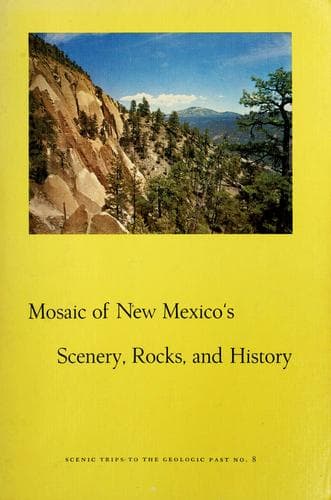
Mosaic of New Mexico's Scenery, Rocks, and History
History
Mosaic of New Mexico's Scenery, Rocks, and History
Geology -- New Mexico; New Mexico -- Description and travel; New Mexico -- History
An unexplained and precipitous decline struck the bandtail pigeon about
ten or twelve years ago, from which it apparently has never recovered.
Although hunting was undoubtedly part of the pressure exercised against
these birds, it in no way accounted for their sudden and dramatic
decline in numbers. This decline may gradually be reversed, since more
and more of these birds are being seen. It is well known that animals
with a high reproductive capacity can endure much heavier losses to
their population than can those with low or very limited reproduction,
such as the bandtail, which normally lays only a single egg. The
mourning dove, on the other hand, lays two eggs at a time and may raise
as many as five or more broods in one year. Take this one step further
with the scaled or Gambel quail, which may lay up to 12 or 15 eggs, and
it can readily be seen that the population of bandtail pigeons can never
endure the losses that the much more prolific mourning dove and quail
can. The same might be said by comparison of elk and deer. Elk do not
bear their first young until their third year, and then the cow may not
bear young but alternate years until her seventh or eighth year; by that
time she has begun to decline in vigor; in her total life she may not
produce more than four or five calves. The mule deer, on the other hand,
start bearing at the age of two, with their first birth normally single;
from then on, twins are usual for the rest of the doe’s life. Thus, deer
have a considerably greater reproductive potential than do elk or
bighorn sheep, which have one young at a time.
The fleet-footed antelope of the open rolling plains is another example
of fairly high reproductive capacity, since they breed earlier than do
deer and normally bear twins. Antelope are confined to the more open
country where their prodigious running ability and marvelous eyesight
stand in good stead in protecting them against their natural enemies.
The wild turkey, classified by law in New Mexico as big game, is found
throughout the mountainous areas of the state, not excepting some of the
desert ranges. New Mexico is one of two states fortunate enough to
possess three of the five forms of the wild turkey known to the United
States: the Merriam turkey, found in the higher elevations of the
mountainous areas, usually the ponderosa forest; the Rio Grande turkey,
confined to the watercourses of the eastern plains; and the fairly rare
Mexican turkey, found in the Animas and Peloncillo mountains of extreme
southwestern New Mexico. In Hildalgo County these mountains are actually
largely Mexican in both flora and fauna. Some of the rarest, most
beautiful birds of North America are also found in this area and nowhere
else in the United States with the exception of southeastern Arizona.
Public-domain text, read in full here on John Shaqi.
Reviews
Reviews
No reviews yet
Be the first to share your thoughts on this work.
Join the Discussion
Join the discussion
Sign in to leave a comment or review.
Sign InorCreate an account