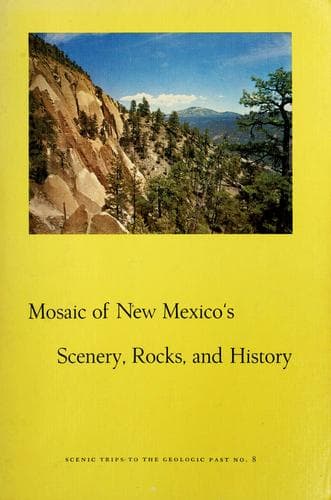
Mosaic of New Mexico's Scenery, Rocks, and History
History
Mosaic of New Mexico's Scenery, Rocks, and History
Geology -- New Mexico; New Mexico -- Description and travel; New Mexico -- History
Our most abundant game bird, the mourning dove, is found in every county
of the state and nests from the coniferous forests of the north and the
higher mountains of the south clear out into the plains where there is
not a tree in sight for miles. Doves are extremely adaptable and very
prolific. They provide the finest kind of sport shooting and are avidly
sought, particularly by shotgun enthusiasts of the eastern and southern
parts of the state.
Scaled quail are found throughout New Mexico, being absent only in
elevations above 7000 feet. Even there, they periodically occur but are
ordinarily driven back by winter snow. Gambel quail are found throughout
the river courses of the Rio Grande Valley, the San Juan Valley, and the
southwestern watercourses. The Mearns’ quail is found in the southern
half of the state in the higher mountain elevations, whereas the
bob-white quail occupies the grassy rolling sandhills of the eastern
counties where it is commonly found together with scaled quail.
Quail hunting is one of the most popular sports in New Mexico and many
thousands of hunters can hardly wait from one season to the next. New
Mexico is in the heart of the scaled quail country and provides some of
the finest shooting to be had anywhere.
Migratory waterfowl, while not considered abundant, are not uncommon in
this state, known more for its aridity than for its rivers and lakes.
The two main fly ways are the Rio Grande Valley and the Pecos Valley,
with the Pecos Valley being somewhat ahead in total numbers.
Ducks commonly found in New Mexico in abundance are teal, both
green-winged and blue-winged as well as the lesser-known cinnamon teal,
mallards, widgeon, pintails, gadwall, scaups, canvasbacks, redheads, and
other species.
In addition, New Mexico plays winter home to many thousands of the
lesser sandhill crane which is confined to the river valleys and open
plains of the eastern part of the state, particularly the southeastern
counties. A smaller population of the greater sandhill crane is found in
the Rio Grande Valley and near Columbus. Flocks of the small
Richardson’s goose are found in the northeastern counties, in
particular, and along river courses throughout the state. The small snow
goose is likewise confined mostly to major river courses. The larger
Canada geese are found particularly in the middle Rio Grande Valley
where extensive development has been made by both state and federal
agencies to encourage the use and the presence of bands of geese.
Public-domain text, read in full here on John Shaqi.
Reviews
Reviews
No reviews yet
Be the first to share your thoughts on this work.
Join the Discussion
Join the discussion
Sign in to leave a comment or review.
Sign InorCreate an account