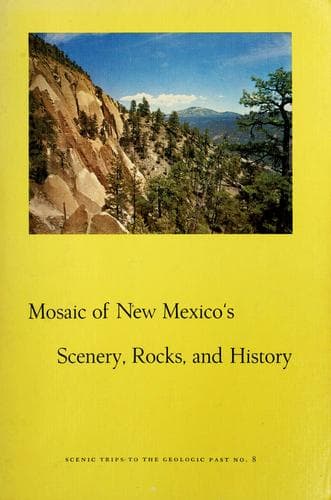
Mosaic of New Mexico's Scenery, Rocks, and History
History
Mosaic of New Mexico's Scenery, Rocks, and History
Geology -- New Mexico; New Mexico -- Description and travel; New Mexico -- History
Long gone are the buffalo which once roamed the High Plains of eastern
New Mexico. Exotic animals, imported and stocked along the rugged canyon
of the Canadian River above Conchas Reservoir, are the Barbary sheep
with their magnificent coiled horns. Beavers dam some of the mountain
streams, badgers and skunks can be seen from the highways, and amid the
forests are squirrels and porcupines, while high on rock slopes, the
Rocky Mountain woodchuck and the gray rock cony dash from ledge to
ledge. The white-tailed ptarmigan also haunts these high crags, and
lower down the mountain, bluebirds nest. Hawks, eagles, magpies, jays,
ravens, orioles, wrens, sparrows, warblers, finches, and many other
birds of endless variety soar over canyon, forest, and sand-dune desert.
Most notable of all is the crested roadrunner, the chapparal cock or
paisano of Mexico and the state bird. In between racing with horsemen or
automobiles, the slender roadrunner cocks his head, strikes swiftly and
victoriously, then swallows his victim, which can be a small
rattlesnake, whole.
Snakes there are aplenty. Mostly, they are nonpoisonous, such as the
garter snake, glass snake, puff adder, ring-necked snake, the coachwhip,
the Mexican blacksnake, and the large western bullsnake. The small but
very venomous coral snake is rare, but common among rocks and near
streams are the large western diamondback rattlesnake, the prairie
rattlers, and the less common green or blacktailed rattlesnake. Every
sun-warmed rock has its scampering lizard, and nearby are horned toads,
dry-land terrapins, tortoises, tarantulas, centipedes, vinegarroons,
scorpions, and spiders. Of these latter desert animals, only the black
widow spider is poisonous.
Contrast in the influence of environments is shown by the animals that
inhabit the “malpais,” the recent flows of black, rough-surfaced lava,
compared with similar animals found among the white gypsum dunes of
White Sands. Black or darkly colored subspecies of mice, plains wood
rats, kangaroo rats, and rock squirrels live on the black lava, whereas
white or pale counterparts of these animals live among the white gypsum
dunes.
[Illustration: Sketch of roadrunner, New Mexico state bird]
The dwellers in the hills and plains of New Mexico are as varied as the
hills and plains; they add their color and movement to the scenes of the
Land of Enchantment.
Rocks That Shape the Enchanting Landscape
_by_ Frank E. Kottlowski
“As old as the hills.” How much more ancient can anything be? Yet New
Mexico’s hills, its enchanting landscapes, were built in but the most
recent “minute” of geologic time. Merely one geologic era ago, marine
waters covered the state, and storm-tossed waves ruled where now the hot
sun beats down on dry sands and cacti a mile above sea level.
Public-domain text, read in full here on John Shaqi.
Reviews
Reviews
No reviews yet
Be the first to share your thoughts on this work.
Join the Discussion
Join the discussion
Sign in to leave a comment or review.
Sign InorCreate an account