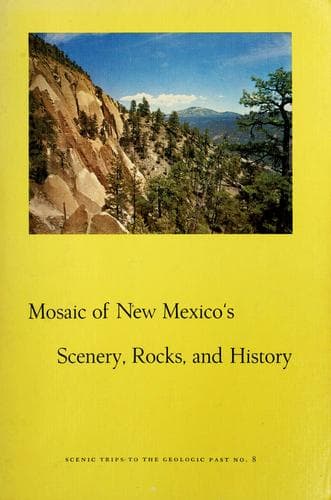
Mosaic of New Mexico's Scenery, Rocks, and History — John Shaqi
Mosaic of New Mexico's Scenery, Rocks, and History
History
Mosaic of New Mexico's Scenery, Rocks, and History
Geology -- New Mexico; New Mexico -- Description and travel; New Mexico -- History
What determined the Land of Enchantment’s landscapes? Shaping these land
forms are the rocks of the earth’s crust, the structure of those rocks,
and the endless battle between the rocks and the atmosphere. A story
spelled out in stone, the geologic history. The rocks determine.
Eons ago, it began; one billion, two billion, or perhaps even more
billions of years ago. A history whose beginnings have been lost owing
to destruction of its earliest records. A history, written in the rocks,
that is divided into four general parts (fig. 1). The oldest rocks, more
than 600 m.y. (million years) old, almost devoid of traces of life, are
the Precambrian rocks. The Paleozoic rocks, 230 to 600 m.y. old, are
marked by ancient (_paleo_-) life. This was the Period of Invertebrates,
animals without backbones. Mesozoic rocks, 70 to 230 m.y. old, formed in
the Era of Dinosaurs and contain types of life that are intermediate
(_meso_-) between the ancient and modern animals. And rocks of the
Cenozoic Era, 70 m.y. ago to the present, make up the latest (_ceno_-,
recent) chapter of the earth’s history.
Events of the Cenozoic Era have had the greatest influence on New
Mexico’s landscapes. So let us begin the story at the dawn of the
Cenozoic, and return to the earlier geologic chapters later.
CENOZOIC ERA
The mountains, the plains, the rivers, and the lakes all are transitory
features of the landscape, created during the recent part of the
Cenozoic Era, and all doomed to destruction in the near future,
geologically speaking. Even so, some of the plains and mountains may
predate man’s evolution onto the earth scene.
Gone were the late Mesozoic seas; never again during our lifetime nor
the lifetime of many future generations will marine waters roll over New
Mexico, and sea-spawned creatures rule. For the first two thirds of the
Cenozoic, the Paleogene Period (25 to 70 m.y. ago), New Mexico suffered
from the dying effects of the great Laramide upheaval of the earth’s
crust. Large areas were exposed to the harsh erosion of stream and wind.
The landscape looked as parts of southwestern New Mexico do today—tall
rugged mountain ranges scattered in isolated patches amid wide gravelly
plains. But the climate was more humid, and while no large through
rivers are known, local great swamps and lakes lay on the plains in
debris-trapping lowlands.
[Illustration: Figure 1. Table of geologic time]
_Scale of geologic time
in millions of years_
_Era_ _Rocks_ _Dominant life_
_Geologic age_
Public-domain text, read in full here on John Shaqi.
Reviews
Reviews
No reviews yet
Be the first to share your thoughts on this work.
Join the Discussion
Join the discussion
Sign in to leave a comment or review.
Sign InorCreate an account