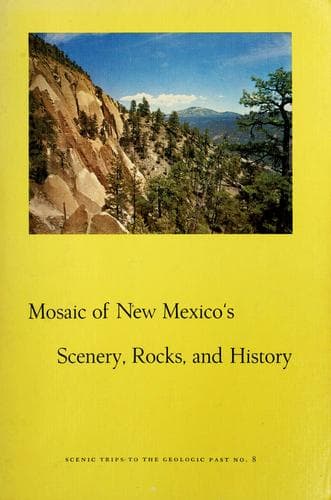
Mosaic of New Mexico's Scenery, Rocks, and History
History
Mosaic of New Mexico's Scenery, Rocks, and History
Geology -- New Mexico; New Mexico -- Description and travel; New Mexico -- History
In the world of the twentieth century with its tumultuous ovation for
each discovery of science, with its language of non-Euclidian space,
with new heroes who leave the earth, not discover it—sometimes it is
refreshing to look back on other days, to see other heroes, and to seek
romance and excitement which was equally spectacular in times past. Yet
there is a close affinity and a spiritual link among the heroes of the
past, the present, and the future, and the reaction of their
contemporaries to their feats of glory is not so different. Heroes are
those who seek the unknown, who risk life and position to expand the
frontiers of man’s universe and mind. But heroes can only lead an age,
never surpass it. History, then, is people and their catalyst, ideas.
The history of New Mexico, like twentieth century science, is
multi-dimensional. Its complex cultural patterns fit with the intricate
variety of its geologic wonders and its flora and fauna. In reality, New
Mexico is a part of a broader concept, the Southwest. This vast region,
which includes western Texas, New Mexico, Arizona, southern California,
part of southern Colorado, and southern Utah, has given rise to some of
man’s greatest achievements. Here prehistoric man rose above his animal
heritage to take control of these lands. Here, also, many millennia
later, man achieved one of his greatest scientific wonders, the
successful release of atomic energy. The story of the years between
these events, so far separated in time, is a wondrous tale.
INDIAN BEGINNINGS
Before the coming of the white man, this land belonged to nature’s
children, the Indian. Centuries before European nations came into
existence, peoples from Asia, crossing by the Bering waters, had
discovered, explored, and settled the American continents from Alaska to
Tierra del Fuego. They mastered the plains, the northern forests, the
jungles of Central and South America, and the arid regions. In the
deserts and mountains of the Southwest, they conquered elements and
terrain, first to survive and then slowly to ascend the ladder of
culture.
Public-domain text, read in full here on John Shaqi.
Reviews
Reviews
No reviews yet
Be the first to share your thoughts on this work.
Join the Discussion
Join the discussion
Sign in to leave a comment or review.
Sign InorCreate an account