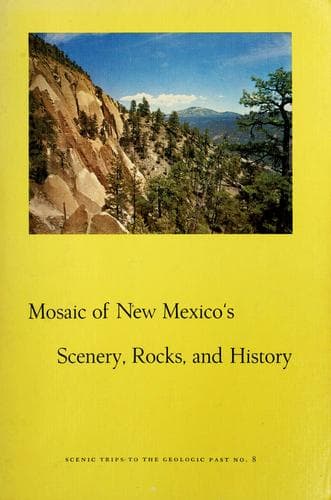
Mosaic of New Mexico's Scenery, Rocks, and History
History
Mosaic of New Mexico's Scenery, Rocks, and History
Geology -- New Mexico; New Mexico -- Description and travel; New Mexico -- History
At first they were foragers, living on what nature provided. At the time
of Christ, several groups could be distinguished: In the Colorado River
drainage, south of the Grand Canyon, were the Yuman Foragers; in
southeastern Arizona and southwestern New Mexico were the Mogollon
people; in the Four Corners area (where the states of Utah, Colorado,
Arizona, and New Mexico meet) and in the Rio Grande Valley of New Mexico
was a complex of cave sites that evidenced a forager type of culture.
But, as man always aspires to rise above his environment, the Indian
slowly and painfully learned to make tools, developed new techniques,
and finally made the great step upward; he domesticated plants.
Agriculture, based primarily on the growing of corn, came to the Four
Corners before the Christian era. Gradually, out of the primitive
foragers, there developed across the Southwest a complex pattern of
agricultural societies; peaceful farmers intent upon harvesting the
utmost from a harsh land. In Arizona, the Hohokam peoples created a
culture based upon irrigation. In the valleys of the upper Gila and
Mimbres rivers of southwestern New Mexico, several branches of the
Mogollon culture grew and prospered. In the Four Corners area and in the
upper Rio Grande Valley, the Mesa Verde, the Gran Chaco, and later the
Rio Grande branches developed, at first in the cliffs of the high
country, then in open villages along the main tributaries of the Rio
Grande. That there were numerous and varied cultures is attested to by
the ruins one finds scattered throughout the Southwest. Along now dry
arroyos, on buttes overlooking rivers or dry river beds, among cliffs in
the mountain fastnesses and in caves wherever they appear, there are
thousands of sites whose people and history are lost in antiquity.
[Illustration: Prehistoric Indian cliff dwelling]
And these people were builders. They lived in caves at first, then in
crude pit houses. Finally they moved above the ground and evolved
building techniques and styles of architecture that stood the ravages of
time and still serve the people of the Southwest. In the city of Santa
Fe, the Palace of the Governors was built upon the ruins of an Indian
pueblo (village), the name of which has disappeared even from tradition,
and its massive walls of puddled adobe, laid down before the art of
making bricks was introduced by the Spanish, may be seen under glass in
some of the rooms of the Palace at the present time. Perhaps most
spectacular are the great houses of Chaco Canyon, some of which must
have sheltered from one to two thousand people each, and which as
achievements in building, both from the standpoint of durability and
graceful construction, rival the structures of the historic valleys and
plateaus of the ancient eastern world.
Public-domain text, read in full here on John Shaqi.
Reviews
Reviews
No reviews yet
Be the first to share your thoughts on this work.
Join the Discussion
Join the discussion
Sign in to leave a comment or review.
Sign InorCreate an account