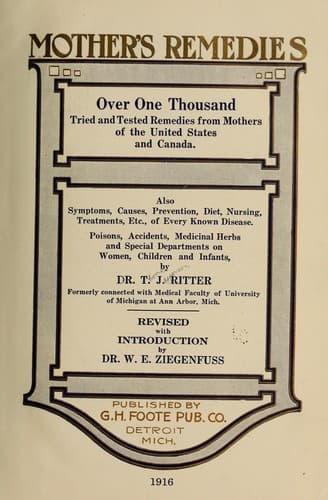
Mother's Remedies: Over One Thousand Tried and Tested Remedies from Mothers of the United States and Canada — John Shaqi
Mother's Remedies: Over One Thousand Tried and Tested Remedies from Mothers of the United States and CanadaRitter, Thomas Jefferson
Science
Mother's Remedies: Over One Thousand Tried and Tested Remedies from Mothers of the United States and Canada
Ritter, Thomas Jefferson
Etiquette; Formulas, recipes, etc.; Medicine, Popular
The mucous membrane lining the nasal passages is similar to other mucous
membranes. It is here called the Schneiderian membrane after the name of a
German anatomist named Schneider. It is continuous through the ducts with
the mucous membrane of all the various accessory cavities of the nose. It
is quite thin, in the upper part over the superior turbinate bone and
partition (septum) while it is quite thick over the lower turbinate bone,
the floor of the nose cavity and the lower part of the partition. It is
well supplied with blood vessels, veins, and glands for producing the
necessary secretion.
The nose is an organ of breathing (respiration) and it warms and moistens
the air we breathe and arrests particles of dust in the air before they
enter the lungs. If the air we breathe is of an uneven temperature, or of
marked degree of dryness, or if it is saturated with impurities, it always
acts as a source of irritation to the mucous membrane of the upper
respiratory tract, like the larynx. By the time the air reaches the
pharynx, through the nose, it has become almost as warm as the blood, and
also is well saturated with moisture. The mucous membrane that lines the
nose cavity and especially that part over the lower turbinate bone,
secretes from sixteen to twenty ounces of fluid daily. This fluid cleanses
and lubricates the nose and moistens the air we breathe. Conditions may
arise which interfere with this natural secretion. This may be due to the
fact that some of the glands have shrunk or wasted (atrophied) and the
secretion has become thick. This collects in the nose, decomposes and
forms scabs and crusts in the nostrils. In this condition there will be
dropping of mucus into the throat. This condition is usually only a
collection of secretions from the nose,--which are too thick to flow
away,--collect in the space behind the nose, and when some have
accumulated, drop into the pharynx.
[8 MOTHERS' REMEDIES]
Public-domain text, read in full here on John Shaqi.
Reviews
Reviews
No reviews yet
Be the first to share your thoughts on this work.
Join the Discussion
Join the discussion
Sign in to leave a comment or review.
Sign InorCreate an account