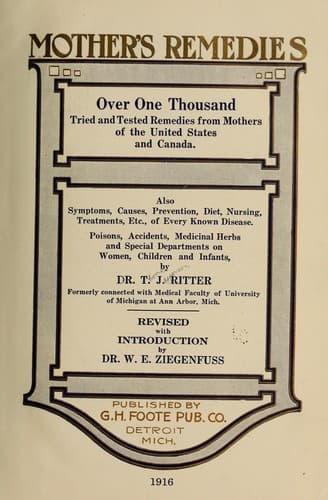
Mother's Remedies: Over One Thousand Tried and Tested Remedies from Mothers of the United States and Canada — John Shaqi
Mother's Remedies: Over One Thousand Tried and Tested Remedies from Mothers of the United States and CanadaRitter, Thomas Jefferson
Science
Mother's Remedies: Over One Thousand Tried and Tested Remedies from Mothers of the United States and Canada
Ritter, Thomas Jefferson
Etiquette; Formulas, recipes, etc.; Medicine, Popular
In order to be in good health it is necessary to breath through the nose,
and to do this there must be nothing in the nose or upper part of the
pharynx to interfere with the free circulation of the air through these
cavities. The cavities of the nose may be partly closed by polpi (tumors)
on the upper and middle turbinate bone, a spur on the (septum) partition,
deviation of the partition or enlarged turbinate bones, or adenoids in the
upper part of the pharynx. These troubles almost close up the nose
sometimes and the person is compelled to breathe through his mouth. He not
only looks foolish, talks thick, but is laying up for himself future
trouble. By correcting the trouble in the nose and removing the adenoids
in the upper part of the pharynx the patient can breathe through the nasal
passages. If you take a tube you can pass it straight back through the
lower channel (meatus) into the pharynx. It will touch the upper back wall
of the pharynx. If the tube has a downward bend you can see it behind the
soft palate and by attaching a string to that end you can draw it back out
through the nostrils. In that way we plug the posterior openings (nares).
The upper part of the pharynx reaches higher up behind than a line drawn
horizontally above the tip of the nose to the pharynx. It reaches forward
above the soft palate on its front surface. Its front surface is almost
directly on a vertical line with tonsil, above the soft palate. On its
upper part and on the side near the nose cavity is the opening of the
eustachian tube.
The name naso-pharynx means the junction of the nose and pharynx.
Sometimes the upper posterior wall of the pharynx, called the vault of the
pharynx, especially the part behind each eustachian tube, is filled almost
full with adenoids. These are overgrowths or thickenings of the glandular
tissue in the upper posterior wall of the pharynx (vault of the pharynx).
ADENOIDS. (Pharyngeal Tonsil, Lursehkas Tonsil, Adenoid Vegetation, Post-
nasal Growth.)--Adenoids are overgrowths or thickenings of the glandular
tissue in the vault (top) of the pharynx. They are on the upper posterior
wall of the pharynx, often filling the whole space, especially the part
behind the ear-tube--eustachian tube.
They are a soft pliable mass, well supplied with blood vessels, especially
in children. Some are firmer and these are the kind seen in adults. The
color varies from pale pink to dark red. The structure is similar to
enlarged tonsils.
[RESPIRATORY DISEASES 9]
[Illustration: Adenoids]
Public-domain text, read in full here on John Shaqi.
Reviews
Reviews
No reviews yet
Be the first to share your thoughts on this work.
Join the Discussion
Join the discussion
Sign in to leave a comment or review.
Sign InorCreate an account