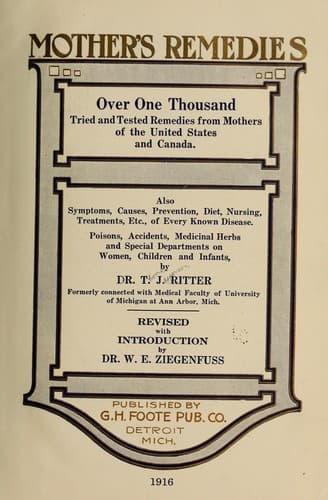
Mother's Remedies: Over One Thousand Tried and Tested Remedies from Mothers of the United States and CanadaRitter, Thomas Jefferson
Science
Mother's Remedies: Over One Thousand Tried and Tested Remedies from Mothers of the United States and Canada
Ritter, Thomas Jefferson
Etiquette; Formulas, recipes, etc.; Medicine, Popular
Chronic catarrh is often caused by adenoids. A chronic pus discharge often
develops, especially in children. There is often a half-pus discharge
trickling over the posterior wall of the pharynx from the nose-pharynx.
And yet some children with adenoids never have any discharge from the
nose. There may be more or less dribbling of saliva from the mouth,
especially in young children, and this is usually worse during sleep.
Headache is not uncommon when these growths persist into adult life: they
continue to give rise to most of the symptoms just described, although
these symptoms may be less marked because of the relatively larger size of
the nose-pharynx. The older patients seek relief, usually, from nasal
catarrh symptoms. They complain of a dry throat on waking and they hawk
and cough, In order to clear the sticky secretion from the throat. The
adenoids have often undergone a considerable amount of shrinking, but they
frequently give rise to a troublesome inflammation of the nose and
pharynx. Rounded or irregular red elevations will often be seen on the
posterior wall of the pharynx, outgrowths of adenoid tissue in this
region. Similar elevations are sometimes seen on the posterior pillars of
the fauces. The tonsils are often enlarged. A good deal of thick discharge
will sometimes be seen in the posterior wall of the pharynx proceeding
from the nose-pharynx.
Although adenoids, like the normal tonsil, usually tend to diminish and
disappear with the approach of youth, they constitute during childhood a
constant source of danger and trouble and not infrequently inflict
permanent mischief. Also children afflicted with adenoids are less able to
cope with diphtheria, scarlet fever, measles, whooping-cough, etc.
Deafness, mouth-breathing habit, and imperfect resonance of the voice, as
well as the characteristic expression of the face, will often remain as
permanent effects of the impairment of function due to these growths in
childhood, even though they have more or less completely disappeared. The
collapsed state of the wings of the nose, and wasted condition of their
muscles, resulting from long disease, often contributes to the
perpetuation of the mouth-breathing habit. On the other hand the rapid
improvement, after a timely removal of the growths, is usually very
striking.
Treatment.--The only thing to do is to remove them soon, no matter how
young the patient may be. An anaesthetic is usually given to children. The
operation does not take long and the patient soon recovers from its
effects. The result of an operation, especially in young children, is
usually very satisfactory. Breathing through the nose is re-established,
the face expression is changed for the better. The symptoms as before
described disappear to a great extent.
COLDS. (Coryza. Acute Nasal Catarrh. Acute Rhinitis).--This is an
inflammation of the mucous membrane lining the nose.
Public-domain text, read in full here on John Shaqi.
Reviews
Reviews
No reviews yet
Be the first to share your thoughts on this work.
Join the Discussion
Join the discussion
Sign in to leave a comment or review.
Sign InorCreate an account