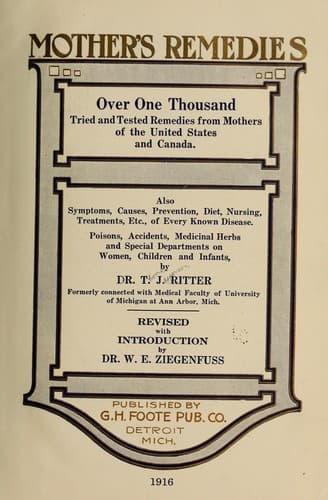
Mother's Remedies: Over One Thousand Tried and Tested Remedies from Mothers of the United States and CanadaRitter, Thomas Jefferson
Science
Mother's Remedies: Over One Thousand Tried and Tested Remedies from Mothers of the United States and Canada
Ritter, Thomas Jefferson
Etiquette; Formulas, recipes, etc.; Medicine, Popular
Symptoms.--Children breathe chiefly or wholly through the mouth. They are
apt to breathe noisily, especially when they eat and drink. They sleep
with their mouth open, breathe hard and snore. They have attacks of slight
suffocation sometimes, especially seen in young children. There may be
difficulty in nursing in infants; they sleep poorly, toss about in bed,
moan, talk, and night terrors are common. They may also sweat very much
during sleep. A constant hacking or barking cough is a common symptom and
this cough is often troublesome for some hours before going to bed.
Troubles with the larynx and pharynx are common and spasmodic laryngitis
appears to be often dependent upon adenoids. Bronchial asthma and sneezing
in paroxysms are sometimes connected with them. The chest becomes
deformed. The prolonged mouth-breathing imparts to adenoid patients a
characteristic look in the face. The lower jaw is dropped and the lips are
kept constantly apart. In many cases the upper lip is short, showing some
part of the upper teeth. The dropping of the jaw draws upon the soft parts
and tends to obliterate the natural folds of the face about the nose,
lips, and cheeks. The face has an elongated appearance and the expression
is vacant, listless, or even stupid. The nose is narrow and pinched, from
long continued inaction of the wings of the nose (alae nasi). The root of
the nose may be flat and broad. When the disease sets in during early
childhood, the palate may become high arched. If the disease continues
beyond second teething, the arch of the palate becomes higher and the top
of the arch more pointed. The upper jaw elongates and this often causes
the front teeth to project far beyond the corresponding teeth in the lower
jaw. The high arched palate is often observed to be associated with a
deflected partition (septum) in the nose.
The speech is affected in a characteristic way; it acquires a dead
character. There is inability to pronounce the nasal consonant sounds; m,
n, and ng and the l, r, and th sounds are changed. Some backwardness in
learning to articulate is often noticed.
Deafness is frequently present, varying in degree, transient and
persistent. Attacks of earache are common and also running of the ears.
The ear troubles often arise from the extension of catarrh from the
nose-pharynx through the eustachian tubes to the middle ear. Sometimes the
adenoids block the entrance to the tubes. The ventilation of the middle
ear may be impeded. Dr. Ball, of London, England, says: "Ear troubles in
children are undoubtedly, in the vast majority of cases, dependent upon
the presence of adenoid vegetation" (growths).
Children with adenoids are very liable to colds in the head, which
aggravate all the symptoms, and in the slighter forms of the disease the
symptoms may hardly be noticeable, except when the child is suffering from
a cold.
[10 MOTHERS' REMEDIES]
Public-domain text, read in full here on John Shaqi.
Reviews
Reviews
No reviews yet
Be the first to share your thoughts on this work.
Join the Discussion
Join the discussion
Sign in to leave a comment or review.
Sign InorCreate an account