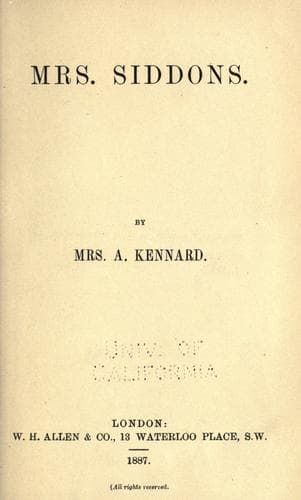
Actresses -- Great Britain -- Biography; Siddons, Sarah, 1755-1831
I heard Mrs. Siddons read at her town-house a portion of _Henry
VIII_. I was more struck and delighted than I ever was with any
reading in my life. This is feebly expressing what I felt. I
felt that I had never before fully understood, or sufficiently
admired, Shakespeare, or known the full powers of the human
voice and the English language. Queen Katherine was a character
peculiarly suited to her time of life and to reading. There
was nothing that required gesture or vehemence incompatible
with the sitting attitude. The composure and dignity, and
the sort of suppressed feeling, and touches, not bursts of
tenderness, of matronly, not youthful tenderness, were all
favourable to the general effect. I quite forgot to applaud—I
thought she was what she appeared. The illusion was perfect,
till it was interrupted by a hint from her daughter or niece, I
forget which, that Mrs. Siddons would be encouraged by having
some demonstration given of our feelings. I then expressed my
admiration, but the charm was broken.
Maria Edgeworth seems to have remained friends with Mrs. Siddons, but her
father, Richard Lovell Edgeworth, hopelessly offended her the first time
he met her:—
“Madam,” he said, “I think I saw you perform Millamant five-and-thirty
years ago.”
“Pardon me, Sir.”
“Oh, then it was forty years ago. I recollect it.”
“You will excuse me, Sir, I never played Millamant.”
“Oh, but I recollect it.”’
“I think,” she said, stiffly turning to Rogers, “it is time for me to
change my place,” and rising with much haughtiness she moved away.
Many amusing stories were current of the dramatic manner which she
imported into daily life. Her question, in the tragic tones of Lady
Macbeth, to the over-awed draper as she bought a piece of coloured print,
“Will it wash?” The solemn reply to the Scotch provost, “Beef cannot be
too salt for me, my Lord”; and “I asked for water, Boy; you’ve brought
me beer.” Lord Beaconsfield told a story of his father, Isaac Disraeli,
returning home after a visit to London, and declaring that the event
that had made most impression on him was hearing Mrs. Siddons say,
“The Ripstone Pippin is the finest apple in the world.” Moore says he
remembered how proud he was of going to Lady Mount Edgcumbe’s suppers
after the opera. It was at one of these, sitting between Mrs. Siddons and
Lady Castlereagh, he heard for the first time the voice of the former
(never having met her before) transferred to the ordinary things of the
world, and the solemn words in her most tragic tone, “I do love ale
dearly.” Sidney Smith also describes her as “stabbing the potatoes”; and
it is said that on hearing of the sudden death of an acquaintance, who
had been “found dead in his bureau,” she understood the latter word to
mean a piece of furniture, and exclaimed, “Poor man! How gat he there?”
Public-domain text, read in full here on John Shaqi.
Reviews
Reviews
No reviews yet
Be the first to share your thoughts on this work.
Elsewhere in the archive
Join the Discussion
Join the discussion
Sign in to leave a comment or review.
Sign InorCreate an account