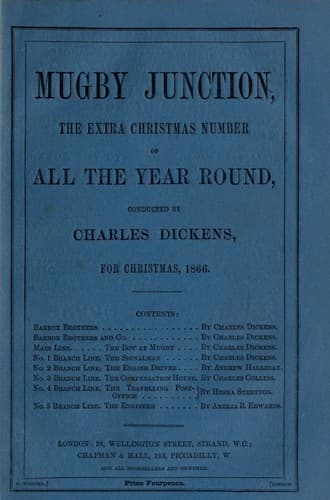
Psychological fiction; Railroad stations -- England -- London -- Fiction
“There was a door between our rooms, and the partition dividing them was
not very solid; and yet I had heard no sound since I parted from him
which could indicate that he was there at all, much less that he was
awake and stirring. I was in a mood, sir, which made this silence
terrible to me, and so many foolish fancies—as that he was lying there
dead, or in a fit, or what not—took possession of me, that at last I
could bear it no longer. I went to the door, and, after listening, very
attentively but quite in vain, for any sound, I at last knocked pretty
sharply. There was no answer. Feeling that longer suspense would be
unendurable, I, without more ceremony, turned the handle and went in.
“It was a great bare room, and so imperfectly lighted by a single candle
that it was almost impossible—except when the lightning flashed—to see
into its great dark corners. A small rickety bedstead stood against one
of the walls, shrouded by yellow cotton curtains, passed through a great
iron ring in the ceiling. There was, for all other furniture, an old
chest of drawers which served also as a washing-stand, having a small
basin and ewer and a single towel arranged on the top of it. There were,
moreover, two ancient chairs and a dressing-table. On this last, stood a
large old-fashioned looking-glass with a carved frame.
“I must have seen all these things, because I remember them so well now,
but I do not know how I could have seen them, for it seems to me that,
from the moment of my entering that room, the action of my senses and of
the faculties of my mind was held fast by the ghastly figure which stood
motionless before the looking-glass in the middle of the empty room.
“How terrible it was! The weak light of one candle standing on the table
shone upon Strange’s face, lighting it from below, and throwing (as I now
remember) his shadow, vast and black, upon the wall behind him and upon
the ceiling overhead. He was leaning rather forward, with his hands upon
the table supporting him, and gazing into the glass which stood before
him with a horrible fixity. The sweat was on his white face; his rigid
features and his pale lips showed in that feeble light were horrible,
more than words can tell, to look at. He was so completely stupefied and
lost, that the noise I had made in knocking and in entering the room was
unobserved by him. Not even when I called him loudly by name did he move
or did his face change.
Public-domain text, read in full here on John Shaqi.
Reviews
Reviews
No reviews yet
Be the first to share your thoughts on this work.
Join the Discussion
Join the discussion
Sign in to leave a comment or review.
Sign InorCreate an account