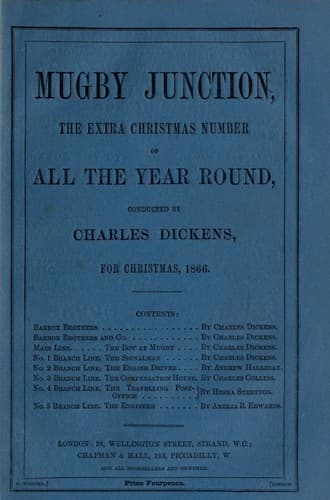
Psychological fiction; Railroad stations -- England -- London -- Fiction
“‘What do you see?’ he asked next.
“‘See?’ I repeated, trying to speak as cheerfully as I could, and
describing the reflexion of his own face as nearly as I could. ‘I see a
very, very pale face with sunken cheeks—’
“‘What?’ he cried, with an alarm in his voice which I could not
understand.
“‘With sunken cheeks,’ I went on, ‘and two hollow eyes with large
pupils.’
“I saw the reflexion of my friend’s face change, and felt his hand clutch
my arm even more tightly than he had done before. I stopped abruptly and
looked round at him. He did not turn his head towards me, but, gazing
still into the looking-glass, seemed to labour for utterance.
“‘What,’ he stammered at last. ‘Do you—see it—too?’
“‘See what?’ I asked, quickly.
“‘That face!’ he cried, in accents of horror. ‘That face—which is not
mine—and which—I SEE INSTEAD OF MINE—always!’
“I was struck speechless by the words. In a moment this mystery was
explained—but what an explanation! Worse, a hundred times worse, than
anything I had imagined. What! Had this man lost the power of seeing
his own image as it was reflected there before him? and, in its place,
was there the image of another? Had he changed reflexions with some
other man? The frightfulness of the thought struck me speechless for a
time—then I saw how false an impression my silence was conveying.
“‘No, no, no!’ I cried, as soon as I could speak—‘a hundred times, no! I
see you, of course, and only you. It was your face I attempted to
describe, and no other.’
“He seemed not to hear me. ‘Why, look there!’ he said, in a low,
indistinct voice, pointing to his own image in the glass. ‘Whose face do
you see there?’
“‘Why yours, of course.’ And then, after a moment, I added, ‘Whose do
you see?’
“He answered, like one in a trance, ‘_His_—only his—always his!’ He
stood still a moment, and then, with a loud and terrific scream, repeated
those words, ‘ALWAYS HIS, ALWAYS HIS,’ and fell down in a fit before me.
* * * * *
“I knew what to do now. Here was a thing which, at any rate, I could
understand. I had with me my usual small stock of medicines and surgical
instruments, and I did what was necessary: first to restore my unhappy
patient, and next to procure for him the rest he needed so much. He was
very ill—at death’s door for some days—and I could not leave him, though
there was urgent need that I should be back in London. When he began to
mend, I sent over to England for my servant—John Masey—whom I knew I
could trust. Acquainting him with the outlines of the case, I left him
in charge of my patient, with orders that he should be brought over to
this country as soon as he was fit to travel.
Public-domain text, read in full here on John Shaqi.
Reviews
Reviews
No reviews yet
Be the first to share your thoughts on this work.
Join the Discussion
Join the discussion
Sign in to leave a comment or review.
Sign InorCreate an account