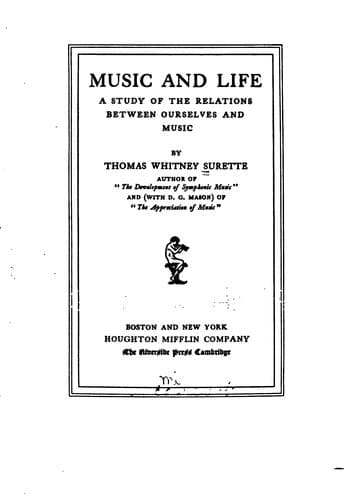
Music and Life: A study of the relations between ourselves and music — John Shaqi
Music and Life: A study of the relations between ourselves and musicSurette, Thomas Whitney
History
Music and Life: A study of the relations between ourselves and music
Surette, Thomas Whitney
Music -- History and criticism
From the law of gravity to Shelley’s “To a Skylark,” beauty is
the central element. In physics, in mathematics, in astronomy, in
chemistry, there is the same perfection of order and sequence, the same
correlation of forces, the same attraction of matter which, operating
in the fine arts, brings about what we call “painting,” “sculpture,”
“poetry,” and “music.” The whole of nature is a postulate of this
doctrine, and there is no subject taught from kindergarten to college
which may not be taught as in accord with it. There is a rhythm of
beauty in all things animate and inanimate--an endless variety around
a central unity. The individuality in nature and in human life is as
a rhythmic diversity to a divine and central unity. The leaves of a
maple tree are all alike and all different; the difference between
the mechanical arts and the fine arts is a difference of rhythmic
flexibility: one is fixed in rhythm in accordance with physical laws,
and acts in perfect sequence and regularity; the other is a free
individualized rhythmic play around a fixed center. The painter may
not dispose the objects on his canvas as he pleases--nature allows him
only a certain freedom; the sculptor may distribute his weights and
his rhythms around the axis with only so much freedom from the demands
of nature as his particular purpose justifies; even the strain of
music, which seems to wander so much at will that it is often called a
“rhapsody,”--it, too, is merely a play of rhythms and contours around
a fixed center, and conforms to a common purpose just as a maple leaf
does. A machine acts in mechanical synthesis, a melody acts in æsthetic
synthesis; neither is free. So we say there is no such thing as an
isolated fact, or subject, or idea.
Thus everything taught to children can be taught as beauty, and if it
is not so taught, its very essence must dissolve and disappear. “The
mean distance from the earth to the moon is about two hundred and forty
thousand miles”; “two and two make four”; “an island is a body of land
entirely surrounded by water”;--so a child learns his lesson in what
are called facts (the most deceptive and soulless things in the world).
To him “the moon” and “a mile” are little more than words; 2 + 2 are
troublesome hieroglyphics; “an island” is, perhaps, merely a word in a
physical geography book; but to you all these objects and quantities
are, perhaps, beautiful; for you
“The moon doth with delight
Look around her when the heavens are bare”;
Public-domain text, read in full here on John Shaqi.
Reviews
Reviews
No reviews yet
Be the first to share your thoughts on this work.
Join the Discussion
Join the discussion
Sign in to leave a comment or review.
Sign InorCreate an account