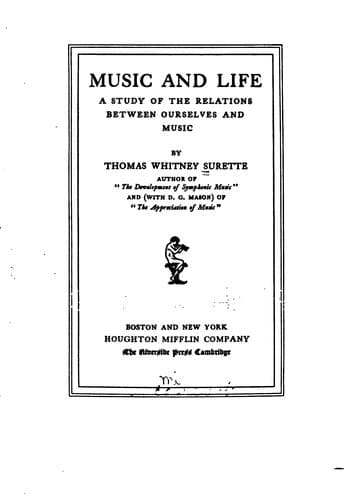
Music and Life: A study of the relations between ourselves and musicSurette, Thomas Whitney
History
Music and Life: A study of the relations between ourselves and music
Surette, Thomas Whitney
Music -- History and criticism
for you numbers have come to have that significance which makes them
beautiful; an island may have touched your imagination as it has
Conrad’s, who calls it “a great ship anchored in the open sea”; you
have seen that beauty which lies behind facts when they fall, as with
a click, into the mechanism of things. So must children be taught to
realize at the very beginning something of that great unity which
pervades the world of thought and of matter. Some comprehension
must be given to them of that marvelous sense of fitting together,
of perfect correspondence, which all nature reveals and which is
ultimately beauty. It is this quality, residing in every subject, which
constitutes the justification for our insistence on beauty as a part of
education.
With our present systems of education all ideality is crushed, for
this ideality is a personal quality, whereas all we are, we are in
mass. “You are trying to make that boy into another you,” said Emerson,
some fifty years ago; “one’s enough.” Modern education, subject to
constant whims, has become a capacious maw into which our children are
thrown. Everything for use, nothing for beauty; for use means money,
while beauty--what is beauty good for?--(a question which Lowell, in
one of his essays, says “would be death to the rose and be answered
triumphantly by the cabbage”). This is indeed an old thesis, but never
has it more needed stating than now. It applies everywhere. Literature
taught as beauty is uplifting and joyful; taught as syntax it is dead
and cheerless. All other forms of instruction lose their force if
they are detached from that poetic harmony of which they are a part.
Numbers, cities, machines, symphonies, the objects on your table, you
yourself,--all these are to be seen as belonging to this harmony,
without which the world is Bedlam.
American children are musical, American adults are not, and the chief
reason lies in the wasted opportunities of childhood. If the natural
taste of our children for music were properly developed, they would
continue to practice it and to find pleasure in doing so, and thus
would avoid the fatal error of _postponing their heaven to another
time_--the great mistake of life and of theology.
I desire therefore to deal here with the possibilities which music
offers to children, not to a few children in playing the pianoforte,
but to all children in love and understanding. It is obviously
desirable to make them all love music, and, since few of them ever
attain satisfactory proficiency in playing instruments, our chief
problem lies in trying to develop their taste and thereby keeping their
allegiance.
II. THE VALUE OF SINGING
Public-domain text, read in full here on John Shaqi.
Reviews
Reviews
No reviews yet
Be the first to share your thoughts on this work.
Join the Discussion
Join the discussion
Sign in to leave a comment or review.
Sign InorCreate an account