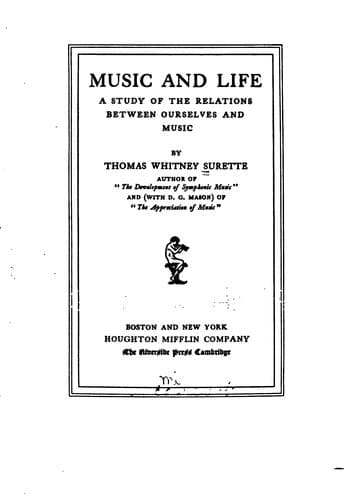
Music and Life: A study of the relations between ourselves and music — John Shaqi
Music and Life: A study of the relations between ourselves and musicSurette, Thomas Whitney
History
Music and Life: A study of the relations between ourselves and music
Surette, Thomas Whitney
Music -- History and criticism
This basis, to which I refer, is both actual and ideal. Many great
composers have used actual folk-melodies. The chorales in Bach’s “St.
Matthew Passion,” for example, are based on traditional melodies.
In Haydn’s instrumental compositions folk-songs are often used
_verbatim_, and the total number of them to be found in his works is
very great. Notable examples may be found in Beethoven--as in the
“Rasoumoffsky” quartettes, and the Seventh Symphony--while Schubert,
Brahms, and Tschaikovsky used folk-melodies freely. Dvořák and Grieg
are essentially national in their idiom and style, and folk-music may
be said to be the basis of the music of each. Ideally the debt of music
to folk-song is greater still. Any typical, _Adagio_ of Beethoven (such
as that in the so-called “Pathétique Sonata”) springs from folk-song,
and, in spite of the long process of development through which music
had passed, reflects--in a more mature form--the same sentiment one
finds in the original. How could it be otherwise? Is there any art, or
any other intellectual activity of man, of which the same thing cannot
be said? Were not Keats and Shelley waiting to be born of Coleridge
and Wordsworth? Is there such a thing as a fruit without a vine; a
blossom without a stem; an end without a beginning? There have been
composers, poets, and painters who have lived detached from the common
consciousness--like those strange organisms in nature that float in
sea or air and draw nothing from the earth’s native soil; but all
the greatest minds have been rooted in the past and have drawn their
inspiration from common human experience. Keeping in mind, then, that
our object is to train the taste of children so that they will love
the best music, let us examine what is actually taking place in the
teaching of music to children.
III. CURRENT METHODS OF TEACHING
The most common fallacy in our teaching consists in putting knowledge
before experience, or theory before practice. Children are taught
_about_ music before they have had sufficient experience of it. They
are taught, for example, to pin pasteboard notes on a make-belief
staff; they are told that one note is the father-note and another the
mother-note (one supposes the chromatics to be irascible old-maid
aunts); all sorts of subterfuges are resorted to in an attempt to teach
them what they are too young to learn and what, in any case, can have
no significance whatever except when based on a long process of actual
experience. One might as well try to satisfy a hungry child with a
picture of an apple as to show a child notes before it has dealt with
sounds.
Public-domain text, read in full here on John Shaqi.
Reviews
Reviews
No reviews yet
Be the first to share your thoughts on this work.
Join the Discussion
Join the discussion
Sign in to leave a comment or review.
Sign InorCreate an account