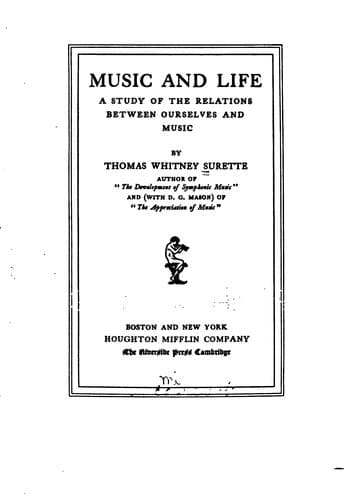
Music and Life: A study of the relations between ourselves and musicSurette, Thomas Whitney
History
Music and Life: A study of the relations between ourselves and music
Surette, Thomas Whitney
Music -- History and criticism
This principle applies, of course, to the appreciation of any artistic
object whatsoever. One cannot appreciate Whistler’s portrait of his
mother by merely realizing that the subject looks like a typical
Victorian dame, any more than one can appreciate Whitman’s “To the
Man-of-War-Bird” by locating Senegal. Whistler’s idea is expressed
through composition, drawing, and color, and each of these qualities
has a subtlety of its own; the pose of the figure is a thing of beauty
in itself; the edge of the picture-frame just showing on the wall, the
arrangement of curves and spots on the curtain, the tone of the whole
canvas--all these make the picture what it is, and all these we must
comprehend and take delight in. Whitman’s poem is a thing of space and
freedom; the sky is the wild bird’s cradle, man is “a speck, a point on
the world’s floating vast”; the poet’s imagination ranges through the
whole created universe and flashes back over vast reaches of time as if
to incarnate again man in the bird. So this music, which reaches our
consciousness through rhythms, melodies, and harmonies, through form
and style, through the delicate filigree of violins, or the triumphant
blare of horns; which says unutterable things by means of silence;
which means nothing and yet means everything,--this Ariel of the
arts,--this, in all its quality,must find echo within us.
Observation, discrimination, reflection; cultivating the memory for
musical phrases and melodies, disciplining the senses, enlarging the
scope of the imagination, nurturing the sense of beauty--these are the
means and the objects of musical education for children. By such a
process we attain in some measure to that joy which is one of the chief
objects of art, and of which our present situation almost completely
deprives us.
So let me say finally that I wage war here against patent nostrums,
against enforced and joyless music-teaching, against the development of
technical proficiency without taste or understanding; and that I uphold
here a process of musical education which has for its object “being
musical,” and which takes into its fold every child, boy or girl, and
keeps them there as man and woman.
FOOTNOTE:
[4] G. Stanley Hall.
CHAPTER III
PUBLIC SCHOOL MUSIC
I. IDEALS OF PUBLIC SCHOOL EDUCATION
Public-domain text, read in full here on John Shaqi.
Reviews
Reviews
No reviews yet
Be the first to share your thoughts on this work.
Join the Discussion
Join the discussion
Sign in to leave a comment or review.
Sign InorCreate an account