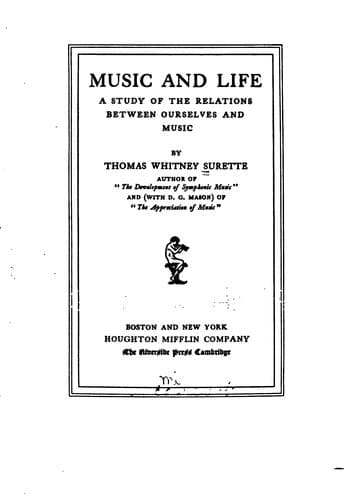
Music and Life: A study of the relations between ourselves and musicSurette, Thomas Whitney
History
Music and Life: A study of the relations between ourselves and music
Surette, Thomas Whitney
Music -- History and criticism
It is characteristic of our compliance in matters educational that of
late years we have seen subject after subject added to the curricula of
our public schools, and have cheerfully voted money for them, without
having much conception of their value or of the results attained
by introducing them. Education is our shibboleth, our formula. The
school diploma and the college degree constitute our new baptism of
conformity. We do not question their authority or their efficacy.
They absolve us. Our public schools have become experimental stations
for the testing of theories, until the demand for more and more
specialization has resulted in an overcrowding of the curricula and
a consequent superficiality in the teaching. “That any man should
die ignorant who is capable of knowledge, that I call a tragedy,”
says Carlyle. But there is a greater tragedy still, which is that
our capability for knowledge may be so overburdened by irrelevant
information that it becomes worthless to us. We study everything and we
know nothing. Our schools become detached from the realities of life
because we pursue so diligently the semblance of those realities.
Our objective is definitely practical. We expect education to fit boys
and girls to cope successfully with the everyday affairs of life, we
frown on anything that savors of the unpractical, and we instinctively
distrust the word “beauty.” We are like Mime who thought that courage
lay in the sword itself. We, too, have the pieces of the broken blade,
and they are as useless to us as they were to him. Of what avail all
this information which we so slowly and painfully acquire? Can it be
put together Mime-fashion? Or is there something that can fuse it? Has
it not all a common source, and is not that source in nature? “Every
object has its roots in central nature and may be exhibited to us so as
to represent the world.” This unity in things, to which Emerson refers,
gives order and sequence to all objects, persons, and ideas; they
become significant and potent, for we see them as they really are. No
one can be said to be educated who fails to apprehend that unification
of all matter, of all thought, of all sensation--that harmony in things
which brings into relation a speck of dust and a star, the individual
and the cosmos. The very thing we fear most in education is the one
thing that tempers all the others--namely, beauty. For in education, as
in everything else, beauty means sequence, order, and harmony; beauty
relates things to each other, multiplies arithmetic by geography,
objects by sounds, acts by feelings. If there were a world with one
human being in it, and only one, his sweetest, gentlest, and most
inevitably perfect act would be to leap-into the mother sea and rejoin
nature. An isolated fact or an unrelated piece of information only
differs in this respect from the human being in that it never was alive.
Public-domain text, read in full here on John Shaqi.
Reviews
Reviews
No reviews yet
Be the first to share your thoughts on this work.
Join the Discussion
Join the discussion
Sign in to leave a comment or review.
Sign InorCreate an account