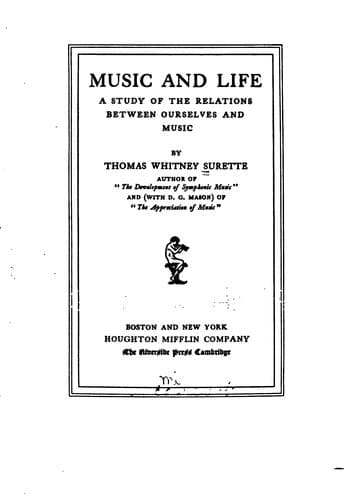
Music and Life: A study of the relations between ourselves and musicSurette, Thomas Whitney
History
Music and Life: A study of the relations between ourselves and music
Surette, Thomas Whitney
Music -- History and criticism
It has been a matter of frequent comment that there has been no such
increase in choral singing either in town or city as our public
school music teaching should lead us to expect. In fact the countless
young people who graduate from our schools seem to make almost no
impression on choral singing. It still remains the least of our musical
activities. It is as difficult as ever to secure people who care enough
for the practice of singing to come to rehearsals. Voluntary choir
singing, for the pleasure to be derived from it, is rare. Are not our
public schools partly responsible for this condition? Is not that
natural taste and love for good music, to which I have just referred,
allowed to lapse and finally almost to disappear? And is not this
largely the result of too much technical instruction, and too little
good music? I know that there are many more distractions for children
than formerly; I know that the home influence in music is slight, and
that parents assume less responsibility for their children than they
used to do. But, granting all this, the musical instruction in public
schools does not fulfill its proper function, nor can it hope to do so
until it changes its ideals.
There is no doubt whatever that, speaking generally, the best music
with which to train the taste of young children is that known as
“folk-song.” The supposition that any musician is capable of composing
a fine enduring song suitable for children is false in its very
essence. The constant appearance of new songs for children and their
inevitable disappearance in the next generation is evidence enough
that this is so, apart from the unmistakable evidence in the songs
themselves. In reality the good tune is right, the poor tune wrong;
the good tune conforms to, is a part of nature; the poor tune is false
in quantity and in sentiment, and not a part of nature. The fine tune
is straightforward, honest, and genuine in sentiment; the inferior
tune professes to be so, but it is not. Fine simple tunes of the kind
suitable for children to sing have been composed,--“Way Down upon the
Suwanee River” is an example,--but they are very few in number. The
only safeguard is to keep chiefly to the old melodies whose quality
has been proved. And since the number of fine folk-tunes is more than
sufficient for our purpose, and since most of them are not copyrighted,
there would seem to be no reason whatever why they should not
constitute the larger part of the music we give our children to sing in
their early years of school life.
Public-domain text, read in full here on John Shaqi.
Reviews
Reviews
No reviews yet
Be the first to share your thoughts on this work.
Join the Discussion
Join the discussion
Sign in to leave a comment or review.
Sign InorCreate an account