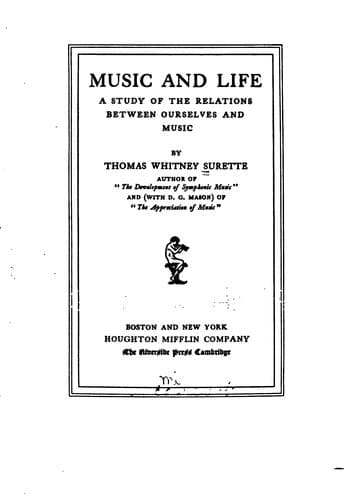
Music and Life: A study of the relations between ourselves and music — John Shaqi
Music and Life: A study of the relations between ourselves and musicSurette, Thomas Whitney
History
Music and Life: A study of the relations between ourselves and music
Surette, Thomas Whitney
Music -- History and criticism
Any discussion of the art of music,--of its significance in relation
to ourselves, of its æsthetic qualities, or of methods of teaching
it,--to be comprehensive, must be based on a clear recognition of the
one important quality which is inherent in it, which distinguishes it
from the other arts and which gives it its peculiar power. Painting
and sculpture are definitive. It is not possible to create a great
work in either of these mediums without a subject taken from life;
for, however imaginative the work may be, it must depict something. In
painting, for example, the very soul of a religious belief may shine
from the canvas,--as in the Sistine Madonna,--but that belief cannot
be there presented without physical embodiment. And when the physical
embodiment is reduced to its simplest terms, as in some of Manet’s
paintings, there is still the necessity of portrayal; Manet’s wonderful
light and opalescent color must fall on an object. Turner paints a
mystical landscape, a mythological vale, such as haunts the dreams
of poets, but it is impossible for him to produce the illusion _by
itself_; the vale is a vale, human beings are there. Sculpture, which
makes its effects by the perfection of its rhythms around an axis, and
by its shadows,--effects of the most subtle and, at the same time,
of the most elemental kind,--it, too, must portray; the emotion must
take form and substance, and that form must be drawn from the outward,
visible world.
In poetry the same limitations exist. It, too, must deal in human life
with a certain definiteness. But the greatest poetry is continually
struggling to slough off the garment of reality and free the soul from
its trammels. It trembles on the verge of music, seeking to find words
for what cannot be said, and attaining a great part of its meaning by a
sublime euphony. The didactic is its grave.
Public-domain text, read in full here on John Shaqi.
Reviews
Reviews
No reviews yet
Be the first to share your thoughts on this work.
Join the Discussion
Join the discussion
Sign in to leave a comment or review.
Sign InorCreate an account