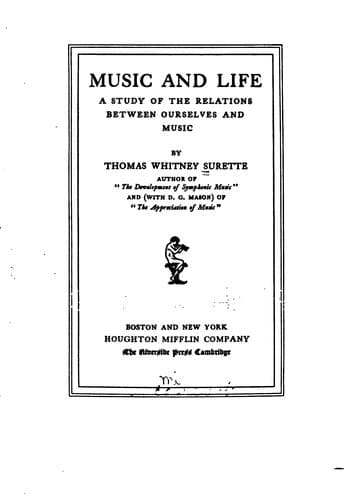
Music and Life: A study of the relations between ourselves and musicSurette, Thomas Whitney
History
Music and Life: A study of the relations between ourselves and music
Surette, Thomas Whitney
Music -- History and criticism
Before I attempt to describe the peculiar quality which distinguishes
music, it will be well to state quite clearly what it cannot do. This
can best be understood by a comparison between it and poetry, which
of all the arts is nearest to music, because it exists in the element
of time, whereas painting and sculpture exist in space. Poetry is
made up of words arranged in meaning and euphony. Each of these words
signifies an object, idea, or feeling; the word “chair,” for example,
has come to mean an object to sit upon. Now, while notes in music are
given certain alphabetical names indicating a pitch determined by sound
waves, the use of these letters is arbitrary and has no connection with
their original hieroglyphic and hieratic significance. The musical
sound we call _a_, for example, means nothing as a sound, has no common
or agreed-upon or archæological significance. Combine the note _a_
with _c_ and _e_ in what is known as the common chord and you still
have no meaning; combine _a_ with other notes and form a melody from
them, and you have perhaps beauty and coherence of form,--a pleasing
sequence of sounds,--but still no meaning such as you get from the
combination of letters in a word like “chair.” Combine _a_ with a great
many other notes into a symphony, and this coherence and beauty may
become quite wonderful in effect, but it still remains untranslatable
into other terms, and without such definite significance as is attained
by combining words in poems. So we say that notes have no significance
in themselves; that musical phrases have no meaning as have phrases in
language; that melodies are not sentences, and symphonies not poems.
If we compare music with painting or sculpture we find much the same
contrast. Just as music does not mean anything in the sense that words
do, so it has no “subject” in the sense that Turner’s The Fighting
Téméraire has, or Donatello’s David. It does not deal with objects. It
cannot portray a ship or a star. It may seem to float, it may flash
for a moment, but it does not describe or set forth. Furthermore, it
cannot, strictly speaking, give expression to ideas. It may be so
serious, so ordered, so equable--as in Bach--that we say its composer
was a philosopher, but no item of his philosophy appears. Above all
it is unmoral,[1] and without belief or dogma. Too much stress can
hardly be laid on this negative quality in music, for it is in this
very disability that its greatest virtue lies. I shall refer later to
the frequent tendency among listeners to avoid facing this problem by
attaching meanings of their own to the music they hear. I need only
note in passing that these so-called “meanings” seldom agree, and that
the habit is the result either of ignorance of the true office of
music, or of mental lassitude toward it. “It is not enough to enjoy
yourself over a work of art,” says Joubert; “you must enjoy it.”
Public-domain text, read in full here on John Shaqi.
Reviews
Reviews
No reviews yet
Be the first to share your thoughts on this work.
Join the Discussion
Join the discussion
Sign in to leave a comment or review.
Sign InorCreate an account