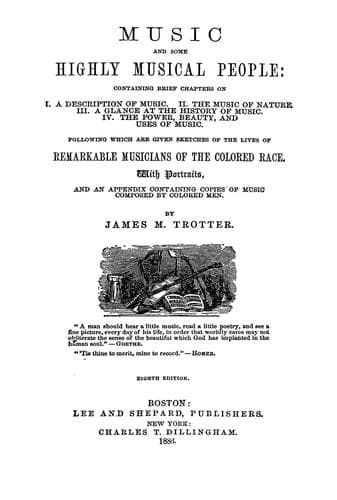
Music and Some Highly Musical PeopleTrotter, James M.
History
Music and Some Highly Musical People
Trotter, James M.
African American musicians -- Biography; African Americans -- Music
Josephus, the learned Jewish historian, states that the Egyptians had
two hundred thousand musicians playing at the dedication of the Temple
of Solomon. This structure was of most wonderfully immense dimensions:
and it may have been that this enormous body of performers played in
_detachments_ about the building; otherwise the statement would seem
apocryphal.
The Egyptian musical instruments, it appears, were mostly of very rude
construction: performance upon them would not now, probably, be
tolerated even in circles of the least musical culture.
Of these ancient instruments the Boston "Folio" thus speaks:--
"The Egyptian flute was only a cow's-horn, with three or
four holes in it; and their harp, or lyre, had only three
strings. The Grecian lyre had only seven strings, and was
very small, being held in one hand. The Jewish trumpets that
made the walls of Jericho fall down were only rams'-horns:
their flute was the same as the Egyptian. They had no other
instrumental music but by percussion, of which the greatest
boast was made of the psaltery,--a small triangular harp, or
lyre, with wire strings, and struck with an iron needle or
stick. Their sackbut was something like a bagpipe; the
timbrel was a tambourine; and the dulcimer, a horizontal
harp with wire strings, and struck with a stick like the
psaltery."
The following interesting and able summary of the history of ancient
Roman music is taken from a recent number of "The Vox Humana:"--
"Art love was not a distinguished characteristic of the
ancient Romans; and we are not astonished, therefore, to
find them borrowing music from Etruria, Greece, and Egypt;
originating nothing, and (although the study was pursued by
the emperors) never finding any thing higher in its practice
than a sensuous gratification.
"In the earliest days of Rome, the inhabitants were
exclusively farmers or warriors; and their first temples
were raised to Ceres or to Mars.
"The priests of Ceres came originally from Asia Minor, and
were called the Arval Brotherhood. Flute-playing was a
prominent feature in their rites, and they were all
proficient upon that instrument. Their number was limited to
twelve.
"The worship of Mars was conducted by the Salian priests,
whom Numa summoned to Rome from Etruria. These also used the
flute as an accessory to their sacrificial rites. In these
primitive days of Rome, much was borrowed from the Etruscans
in style and instruments of music.
Public-domain text, read in full here on John Shaqi.
Reviews
Reviews
No reviews yet
Be the first to share your thoughts on this work.
Join the Discussion
Join the discussion
Sign in to leave a comment or review.
Sign InorCreate an account