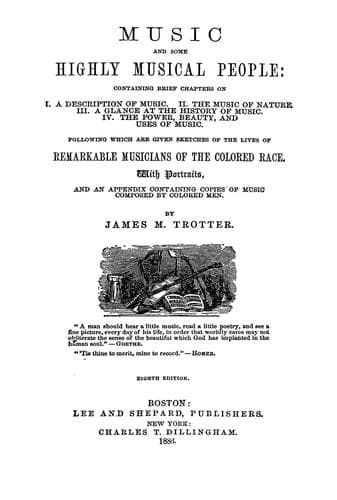
Music and Some Highly Musical PeopleTrotter, James M.
History
Music and Some Highly Musical People
Trotter, James M.
African American musicians -- Biography; African Americans -- Music
"The earliest songs of Rome were in praise of Romulus, and
told the story of the twin-brothers and the divine origin of
the city. They were sung by choruses of boys. Similar songs
were sung during meals by the elders, with an accompaniment
of flutes; these latter songs being especially directed to
the young men, and inciting them to be worthy of the deeds
of their ancestors.
"Under the rule of the emperors, all these worthy
compositions went to decay, and were replaced by a much more
degrading school of music. At no time, however, was music
considered a necessary part of the education of Roman youth.
"There existed in the latter days of ancient Rome some
music-schools; but the study was far less universally
pursued than in Greece at the same epoch. The musical course
has been given by Quintilian as follows:--
"Theoretical: first, arithmetic, physics; second, harmony,
rhythm, metrics.
"Practical: composition, rhythm, melody, poetry.
"Execution: playing instruments, singing, dramatic action;
which makes a rather formidable array, even to modern eyes.
"Among the Roman musical instruments, the flute was the most
popular, and essentially national. We have already stated
that it was used in the worship of their two chief deities:
it was in secular use to a yet greater extent.
"This flute (_tibia_) was hooped with brass bands, and had
an immense resonance. It was used by both sexes; but, on
public and on most religious occasions, was played by men.
"The frequency with which it was used made the art of
playing it a most remunerative one; and the flute-players
soon formed themselves into a guild, or protective society.
This guild had many privileges accorded to it, and existed
for a period of some centuries. The 'Guild of Dionysian
Artists' was a society of later date, and was a musical
conservatory, academy, and agency, all in one. It flourished
greatly under the patronage of various Roman emperors, and
for a long time supplied singers and actors to the Roman
world.
"Valerius Maximus has given an anecdote which shows how
powerful and exacting the guild of flute-players could
afford to be.
Public-domain text, read in full here on John Shaqi.
Reviews
Reviews
No reviews yet
Be the first to share your thoughts on this work.
Join the Discussion
Join the discussion
Sign in to leave a comment or review.
Sign InorCreate an account