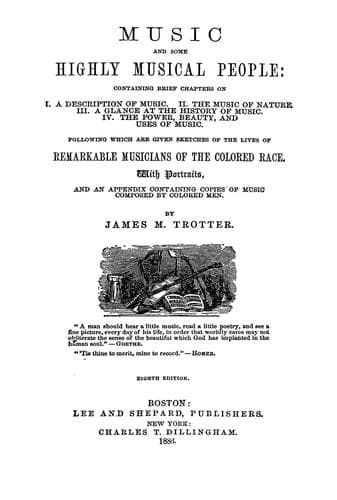
Music and Some Highly Musical PeopleTrotter, James M.
History
Music and Some Highly Musical People
Trotter, James M.
African American musicians -- Biography; African Americans -- Music
"Instruments of percussion were few, and not indigenous to
the Romans: such as were used came from the East, and were
chiefly used in the worship of Eastern deities at Rome. When
the worship of Bacchus was prohibited, they passed away with
that licentious rite. The most complicated instrument of
the ancient world appeared in Rome during the first century
of our era. It was an _organ_, not, as in the scriptural
days, a mere syrinx, or Pan's pipes, but an undoubted organ,
somewhat similar in effect to our modern instrument.
"The instrument is said to have been invented by Ctesbius of
Alexandria in Egypt, who lived about 250 B.C. It did not
appear extensively in Rome, however, until nearly three
hundred years later. This organ has given rise to much
fruitless discussion. In the field of musical history
especially, 'a little' knowledge has proved 'a dangerous
thing;' for, where slight descriptions exist of instruments
of music, latitude is left for every writer to form his own
theory, to fight for it, and denunciate those who differ
from it.
"We have seen what a battle was fought over the three little
manuscripts of Greek music; what a host of differing
opinions were held about the scriptural word 'Selah:' and
now, about this hydraulic organ, each writer mounts his
hobby-horse, and careers over the field of conjecture.
Vitruvius has given a full description of the instrument
from personal inspection; but as his technical terms have
lost all significance to modern readers, and have been
translated in various ways, and as his work contained no
diagrams or illustrations of the various parts, it is
useless.
"Some writers imagine the organ to have had seven or eight
stops,--that is, so many different _kinds_ of tones,--which
would place them nearly on a par with our own. Others think
that they possessed seven or eight _keys_; that is, so many
_tones_ only. It has been a point of dispute as to what
function the water performed in working it. Vitruvius is
rather hazy on this point, saying only that it is
'suspended' in the instrument. The water, when the organ was
played, was in a state of agitation, as if boiling.
"There are medals still in existence which were awarded to
victors in organ contests, on which this instrument is
represented with two boys blowing or pumping; but the
representation is too small to clear up any doubtful
points."
But, without devoting further space to the music that was in vogue
prior to the Christian era, I proceed to notice that our first
reliable account of it, as a system, commences with the fourth
century; at which time St. Ambrose, Bishop of Milan, arranged the
sacred chants that bear his name, and which were to be sung in the
cathedrals.
Public-domain text, read in full here on John Shaqi.
Reviews
Reviews
No reviews yet
Be the first to share your thoughts on this work.
Join the Discussion
Join the discussion
Sign in to leave a comment or review.
Sign InorCreate an account