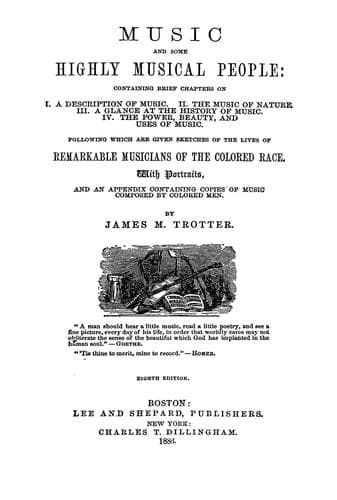
Music and Some Highly Musical PeopleTrotter, James M.
History
Music and Some Highly Musical People
Trotter, James M.
African American musicians -- Biography; African Americans -- Music
"They were one day excluded from the Temple of Jupiter,
where they had been allowed, by ancient custom, to take
their meals; upon which the entire guild left Rome, and went
to the village of Tibur near by. This caused great
embarrassment: no religious services could be held, and
scarce any state ceremony properly conducted. The senate
thereupon sent an embassy to induce them to return,--in
vain: the angry musicians were inflexible. The wily
ambassadors then called the inhabitants of Tibur to their
aid, and these pretended to give a great feast to welcome
the flute-players. At this feast the musicians were all made
very drunk; and, while asleep from the effects of their
liquor, they were bundled into chariots, and driven back to
Rome, where all their old privileges were restored, and
newer and greater ones added.
"They received the right to give public representations and
spectacles in Rome; but at these they were all masked, the
reason being their shame at the manner of their inglorious
return to the city.
"Flutes were used at funerals; and it appears, at one time,
the luxury and pomp of Roman obsequies grew so excessive,
that a law was passed limiting the number of flute-players
on such occasions to ten.
"Only at one time did the flute disappear from any public
worship, and that was when the worship of Bacchus was
introduced into Rome. To this rite the kithara was used; but
this worship, which was somewhat refined, though jovial,
among the Greeks, became among the Romans so debauched and
uxorious, that it was soon prohibited by law.
"The flute was used in combination with other instruments at
times. Apuleius speaks of a concert of flutes, kitharas, and
chorus, and mentions its deliciously sweet effect. It was
also used as a pitch-pipe, to give orators a guide in
modulating their voices when addressing an assembly: thus
Caius Gracchus always on such occasions had a slave behind
him, whose duty it was to aid him to commence his orations
in a proper pitch, and when his voice sank too low, or
became too shrill, to call him to a better intonation by the
sounds of the flute.
"Although the flute was the favorite Roman instrument, it
was by no means the only one. Trumpets were used to a great
extent. A one-toned trumpet, of very loud voice, was used
for battle-signals. These were of very large size, usually
of brass; and their sound is described as 'terrible.' There
was also a smaller (shepherd's) trumpet of mellower tone.
"Another much-used instrument, of different character, was
the _sumphonium_, which did not differ materially from the
modern bagpipe.
Public-domain text, read in full here on John Shaqi.
Reviews
Reviews
No reviews yet
Be the first to share your thoughts on this work.
Join the Discussion
Join the discussion
Sign in to leave a comment or review.
Sign InorCreate an account