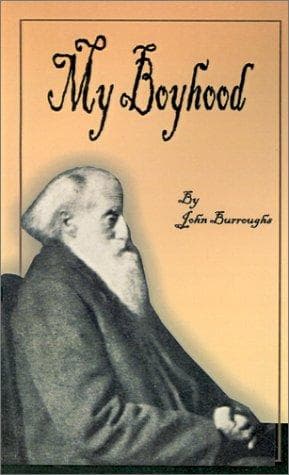
Burroughs, John, 1837-1921 -- Childhood and youth; Naturalists -- New York (State) -- Biography
About three o'clock in the afternoon during the warm weather Mother
would begin skimming the milk, carrying it pan by pan to the big cream
pan, where with a quick movement of a case knife the cream was separated
from the sides of the pan, the pan tilted on the edge of the cream pan
and the heavy mantle of cream, in folds or flakes, slid off into the
receptacle and the thick milk emptied into pails to be carried to the
swill barrel for the hogs. I used to help Mother at times by handing
her the pans of milk from the rack and emptying the pails. Then came the
washing of the pans at the trough, at which I also often aided her by
standing the pans up to dry and sun on the big bench. Rows of drying tin
pans were always a noticeable feature about farmhouses in those days,
also the churning machine attached to the milk house and the sound of
the wheel, propelled by the "old churner"--either a big dog or a wether
sheep. Every summer morning by eight o'clock the old sheep or the old
dog was brought and tied to his task upon the big wheel. Sheep were
usually more unwilling churners than were the dogs. They rarely acquired
any sense of duty or obedience as a dog did. This endless walking and
getting nowhere very soon called forth vigorous protests. The churner
would pull back, brace himself, choke, and stop the machine: one churner
threw himself off and was choked to death before he was discovered. I
remember when the old hetchel from the day of flax dressing, fastened to
a board, did duty behind the old churner, spurring him up with its score
or more of sharp teeth when he settled back to stop the machine. "Run
and start the old sheep," was a command we heard less often after that.
He could not long hold out against the pressure of that phalanx of sharp
points upon his broad rear end.
The churn dog was less obdurate and perverse, but he would sometimes
hide away as the hour of churning approached and we would have to hustle
around to find him. But we had one dog that seemed to take pleasure in
the task and would go quickly to the wheel when told to and finish his
task without being tied. In the absence of both dog and sheep, I have
a few times taken their place on the wheel. In winter and early spring
there was less cream to churn and we did it by hand, two of us lifting
the dasher together. Heavy work for even big boys, and when the stuff
was reluctant and the butter would not come sometimes until the end of
an hour, the task tried our mettle. Sometimes it would not gather well
after it had come, then some deft handling of the dasher was necessary.
Public-domain text, read in full here on John Shaqi.
Reviews
Reviews
No reviews yet
Be the first to share your thoughts on this work.
Join the Discussion
Join the discussion
Sign in to leave a comment or review.
Sign InorCreate an account