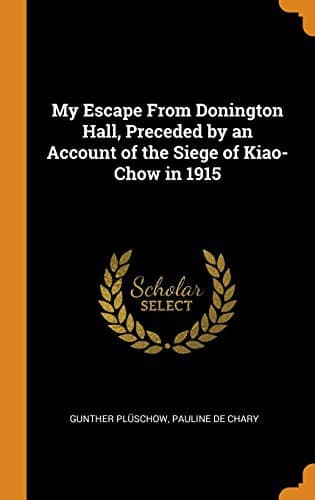
My Escape from Donington Hall, Preceded by an Account of the Siege of Kiao-Chow in 1915 — John Shaqi
My Escape from Donington Hall, Preceded by an Account of the Siege of Kiao-Chow in 1915Plüschow, Gunther
History
My Escape from Donington Hall, Preceded by an Account of the Siege of Kiao-Chow in 1915
Plüschow, Gunther
Prisoner-of-war escapes; World War, 1914-1918 -- Personal narratives, German; World War, 1914-1918 -- Prisoners and prisons, British
Mr. Morgan’s was the hardest task, for he had to interpret the
conversation, which was not devoid of comic aspects.
The battles round Kiao-Chow, the losses of the Japanese and the English
and the flying interested the Chinese most of all. Their questions
never ran dry.
I took hearty and grateful leave of my Mandarin, and the next day I did
the same of my amiable hosts.
When I landed with my aeroplane I had only a tooth-brush, a piece of
soap and my flying-kit, _i.e._ my leather jacket, a scarf and leggings.
I had also taken a civilian suit with me. I now donned the latter.
The five-year-old daughter of our missionary presented me with her
old, shabby little felt hat to replace my sports cap, which a Chinese
had stolen whilst I was dismantling my machine. And in the evening I
was again conducted with ceremony to the junk, which was placed at my
disposal.
My suite, and at the same time guard of honour, during the coming
journey consisted of the Chinese General Lin, well known as a fighter
of pirates, of two officers and forty-five men, apart from the crew of
the boat. I was terribly worn out after all I had been through, and
went to my small wooden room, where to my joy and surprise, instead
of the plank-bed, I found a beautiful sleeping-bag with mattress and
blankets, which the attentive wife of the missionary had sent on board
for me. Without these I should have come off badly in my thin sports
clothes. It was bitterly cold, the wind whistled through the gaps
and crannies, and I could see the starry sky through the awning. And
whilst my thoughts lingered with my brave comrades in Kiao-Chow, and I
gratefully recalled the many battles and dangers I had come through in
order to fulfil my task to the end, sleep overtook me and enfolded me
in its arms.
The journey proceeded by slow stages. The junks were dragged upstream
by two coolies, by means of a rope which was fastened to our masthead.
It took us a day and a half to cover the first stage to Bampu, which I
had flown in twenty minutes with my aeroplane. Later on we went faster,
especially with a favourable wind filling our sails. But it was only
five days later that we arrived at Nanking.
Our progress interested me immensely, for we traversed a criss-cross
of rivers to the famous Emperor’s Channel, and through this we reached
Nanking by way of the Yangtse-kiang. The country was famous for its
pirates, and we passed towns where no European had set foot. During the
day, whilst the junk was being towed along, I walked on the bank with
the General and some of our guards, and watched with great interest the
active and crowded life of these cities, as yet untouched by Western
civilization. Chinese men, women and children came running out of
their houses, stared in astonishment at the sight of a fair man, with
blue eyes, who wore no hat. And they sometimes touched my garments to
convince themselves that I was really human.
Public-domain text, read in full here on John Shaqi.
Reviews
Reviews
No reviews yet
Be the first to share your thoughts on this work.
Join the Discussion
Join the discussion
Sign in to leave a comment or review.
Sign InorCreate an account