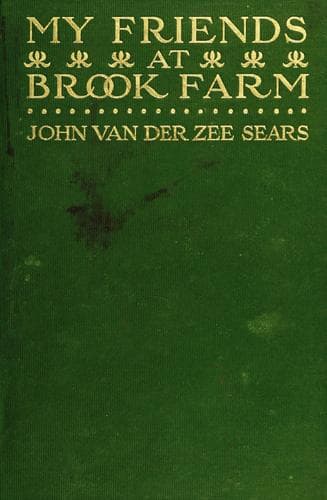
Whether they were overweighted by their ponderous title or whether they
created an artificial atmosphere too etherial for common mortals, the
first generation of Transcendentalists was also the last. They had no
successors and _The Dial_, as their organ, was short lived. It
undoubtedly exercised a considerable influence in its day; and
individual members of the long-named fraternity did much to mould the
thought of the American people in after years. Among these were Ralph
Waldo Emerson, Bronson Alcott, George William Curtis, Francis George
Shaw, translator of Eugene Sue and of George Sand, and father of
Colonel Robert Shaw, Margaret Fuller, Theodore Parker, Dr. Howe and his
fiancee Julia Ward, Charles A. Dana, John S. Dwight and perhaps a score
of other bright spirits. Occasional attendants at their gatherings and
contributors to _The Dial_ were Horace Greeley, William Page, afterward
President of The National Academy of Design, Thomas Wentworth Higginson
and my father, Charles Sears. Their acknowledged leader was the Rev.
George Ripley, the founder of Brook Farm.
I do not know anything more about this old time Transcendentalism than
I do about the Pragmatism of our day, and that is not much. I believe
the two schools of thought were alike in this, they both held that
modern civilization has gone sadly and badly astray in the pursuit of
wealth. Not money but the love of money is, now as ever, the root of
all evil. The first work of the makers of America was necessarily the
creation of property, the accumulation of the means of life, but we
have pushed this pursuit too far, have gone money mad not knowing when
we should stop trying to get rich and give our time and attention to
higher things.
There is another matter to be noted as of some significance namely that
leading Transcendentalists were, and leading Pragmatists now are,
scholars and university men. It is true America was not turning out
university men in the ’40’s and it might perhaps better be said that
the Transcendentalists were college men, but as several of them were
educated in Germany the connotation may be allowed to stand. It was
said of these learned students that at their meetings they read Dante
in the original Italian, Hegel in the original German, Swedenborg in
the original Latin, which language the Swedish seer always used,
Charles Fourier in the original French, and perhaps the hardest task of
all, Margaret Fuller in the original English. Margaret was an honored
member of the illustrious company and was held in high esteem; but her
writings are mighty hard reading. I can quite understand James Russell
Lowell’s judgment in his “Fable For Critics” where he condemns a
certain literary offender to severe punishment, sentencing him to 30
days at hard labor, reading the works of Margaret Fuller.
Public-domain text, read in full here on John Shaqi.
Reviews
Reviews
No reviews yet
Be the first to share your thoughts on this work.
Join the Discussion
Join the discussion
Sign in to leave a comment or review.
Sign InorCreate an account