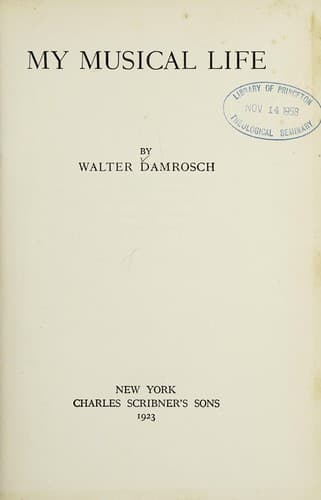
Conductors (Music) -- United States -- Biography; Damrosch, Walter, 1862-1950
It was hard work to keep the two societies going and to enable them to
meet the bills for hall rent, soloists, and orchestra. There was as yet
but a small public for the higher forms of music, and again and again it
looked as if further efforts would have to be abandoned. But my father
persevered and struggled on, making a living for his family by teaching
violin, composition, and singing, and occasionally getting a fee of “a
hundred dollars in gold” as violin soloist or in a chamber-music
concert, officiating as musical director in a church and as conductor of
the German male choral society, the Arion.
The first production of Symphony No. 1, in C minor, by Brahms became a
subject of intense rivalry between the two conductors. Brahms had waited
until his fortieth year before writing a symphony, and the work was
eagerly awaited in New York, as the reports from Germany proved that it
had made a sensation.
My father went to see old Gustav Schirmer at his store on Broadway and
asked him whether the orchestral score of this work had yet arrived.
Schirmer told him that it had, but that he was in honor bound to give it
to Theodore Thomas as he had promised it to him. My father was very much
chagrined to think that this prize should thus have escaped him, and he
spoke of this very regretfully to a pupil of his in composition, Mrs.
James Neilson, member of an aristocratic old family in New Brunswick,
New Jersey, and a woman of great beauty and distinction. Mrs. Neilson
said nothing to my father but quietly went down to Schirmer’s and
inquired of the clerk whether the orchestral score of the Brahms
symphony had arrived, and when he answered in the affirmative, she asked
whether it was for sale. “Certainly,” answered the clerk.
She thereupon purchased a copy of the score and sent it up to my father
with her compliments. His astonishment was intense, but she did not tell
him until weeks afterward how she had obtained it.
He received the score on a Thursday and the first rehearsal for the next
concert was to take place on the following Monday. This left but little
time to obtain the necessary orchestral parts and Schirmer naturally
would not sell him any. He therefore cut the score into three parts and
divided them among three copyists, who worked day and night and managed
to have the parts ready in time for the rehearsal. Great was the triumph
in the Damrosch camp at this victory over the Thomas forces.
Some years later I gave the first performances in New York of the Third
and Fourth Brahms Symphonies, but I had no need to resort to strategem
to obtain the scores and orchestral parts.
Public-domain text, read in full here on John Shaqi.
Reviews
Reviews
No reviews yet
Be the first to share your thoughts on this work.
Join the Discussion
Join the discussion
Sign in to leave a comment or review.
Sign InorCreate an account