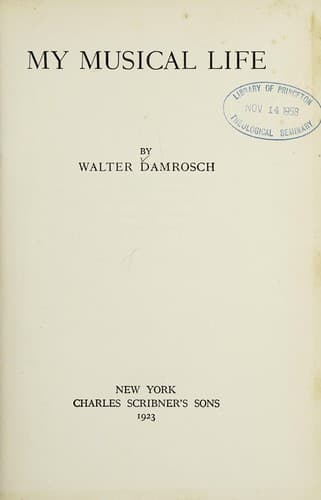
Conductors (Music) -- United States -- Biography; Damrosch, Walter, 1862-1950
Orchestral conditions were bad compared with to-day. There was no such
thing as a “permanent orchestra.” The musicians of the Symphony Society,
for instance, played in six symphony concerts during the winter, each
preceded by a public rehearsal. They also officiated at four concerts of
the Oratorio Society, and this was almost the extent of their efforts in
that direction. The rest of the time they made their living by teaching,
playing in theatres, at dances, and some of them even at political or
military processions and mass meetings. If a better “job” came along
than the symphony concert they would simply send my father a substitute.
Small wonder that occasionally their lips gave out and the first horn or
trumpet would break on an important note during a symphony concert. And
yet, in spite of this disheartening condition, my father succeeded in
infusing the orchestral players with such emotional intensity, and in
imparting so lofty an interpretation to them, that the audiences of that
day were often roused to the greatest enthusiasm; and I would tuck my
arm very proudly into his as we marched home from a concert, even though
we knew that the subscription to the concert was not more than eight
hundred dollars and the single sale at the box-office had not reached
the hundred dollar mark.
But all this was changed like a flash in the year 1879 when my father
decided to perform “The Damnation of Faust,” by Berlioz, until then
unknown in America. This concert, which was held at Steinway Hall, in
East 14th Street, necessitated the services of solo singers, the New
York Symphony Orchestra, the chorus of the New York Oratorio Society and
the male chorus of the Arion Society.
The work and the performance made a sensation. All New York buzzed with
it, and during that winter, 1879, it was given five times in succession
to crowded houses, creating an excitement such as New York had never
before seen in the concert field.
I played in all these performances at the last stand of the second
violins, as my father considered it of the utmost value to me as a
future conductor to be able to follow the conductor’s beat as one of the
orchestra.
IV
AUGUST WILHELMJ—TERESA CARRENO
In the spring of 1878 Maurice Strakosch, an old concert manager, called
on my father and asked him whether he would permit me to go on a
Southern concert tour with the celebrated violinist, August Wilhelmj,
who was then touring the country under Strakosch management. Mr. Max
Liebling, his regular accompanist, had been taken ill and as both
Wilhelmj and Strakosch knew that I had accompanied my father a great
deal at home, they thought that I could acceptably fill the position at
such short notice. I was naturally wild with delight at the idea and
prevailed on my father to let me go. I was to receive the, for me,
munificent salary of a hundred dollars a week and all my railway
expenses.
Public-domain text, read in full here on John Shaqi.
Reviews
Reviews
No reviews yet
Be the first to share your thoughts on this work.
Join the Discussion
Join the discussion
Sign in to leave a comment or review.
Sign InorCreate an account