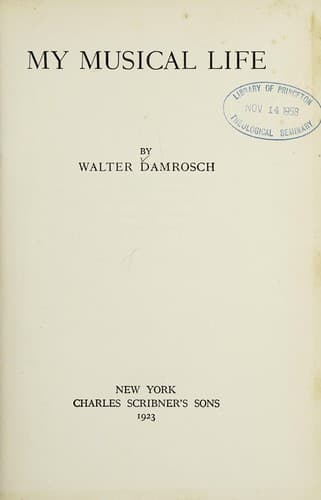
Conductors (Music) -- United States -- Biography; Damrosch, Walter, 1862-1950
My days were certainly busy ones. In the morning I attended the sessions
of Doctor Sauveur in French and Latin and in the afternoon I practised
piano and worked hard at the arranging of the piano score of the Berlioz
“Requiem.” Incidentally, I seemed to find plenty of time for games and
fun of all kinds with a delightful family who had a country place there
and where I got my first real glimpse of American country life, which is
indeed unique and with which no other country can compare.
As fast as the different numbers of my arrangement of the Berlioz
“Requiem” were finished, I sent them on to my father who, after revising
them, gave them to the publisher in order to have the piano scores ready
for the rehearsals in the fall. He was well pleased with my work,
especially the “Tuba Mirum,” in which he thought that I had condensed
quite cleverly the four orchestras which Berlioz intended placed at the
four corners of the stage to represent the trumpets of the last
judgment.
When I returned to New York in September, my father intrusted to me
Section B of the New York Festival Chorus, numbering two hundred voices
and the Newark Harmonic Society of Newark, New Jersey, numbering three
hundred. He himself drilled the chorus of the Oratorio Society of four
hundred at which I always played the piano accompaniments, and Mr.
Cortada, an old pupil of my father’s, trained a section in Brooklyn and
another in Nyack, New York. I hurled myself at my task with such
vehemence and enthusiasm that by the time the Festival came along my
choruses were letter-perfect, but I had become voiceless. My vocal cords
had quite gone back on me in justifiable anger at my abuse of them.
The choral works to be performed included the Berlioz “Requiem,”
Rubinstein’s “Tower of Babel,” Handel’s “Messiah,” Beethoven’s “Ninth
Symphony,” and shorter selections. The monster chorus and orchestra
numbered fifteen hundred, and a special stage and sounding-board were
built at the Seventh Regiment Armory at which the Festival took place.
The organ from St. Vincent’s Church was transferred bodily, and I was
intrusted with the organ accompaniments. An enormous audience of ten
thousand people attended every performance, and the public acclaimed my
father with much enthusiasm as America’s greatest musician. Such happy,
happy days!
Public-domain text, read in full here on John Shaqi.
Reviews
Reviews
No reviews yet
Be the first to share your thoughts on this work.
Join the Discussion
Join the discussion
Sign in to leave a comment or review.
Sign InorCreate an account