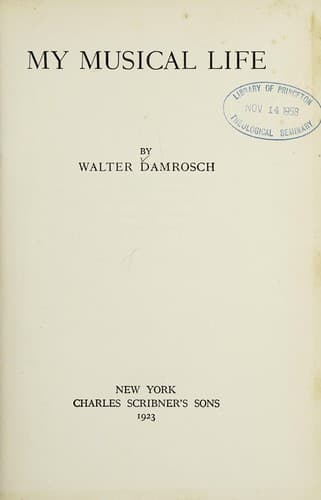
Conductors (Music) -- United States -- Biography; Damrosch, Walter, 1862-1950
Among the many memories of this great occasion I can never forget the
first rehearsal of the four orchestras and sixteen kettledrums which
Berlioz used in the “Tuba Mirum” to depict the Last Judgment. This
rehearsal took place in the Foyer of the old Academy of Music in
Fourteenth Street; and as the sixteen kettledrums came in like one man
just as the fanfare of the judgment Trumpets begins, the effect of these
vibrations in a comparatively small room was so tremendous that one by
one the orchestra men arose and a murmur began which grew and grew and
finally relieved itself in a loud shout of enthusiasm. It was several
minutes before my father could continue the rehearsal. I have never
witnessed anything quite like it since. We are now so sophisticated by
Strauss and the later-day dissonancers that so-called instrumental
“effects” neither shock nor stir us. And as regards the dissonances with
which some of the ultramoderns seek to irritate our ears, I have always
claimed that the human ear is like the back of a donkey—if you whip it
long enough and hard enough, it gradually becomes insensitive to pain.
Theodore Thomas and his supporters were much irritated that my father
should have “gotten ahead” of them with so stupendous a musical
demonstration, and they immediately proceeded to copy his idea by giving
a Music Festival the following year in the same building.
For me, the immediate result of the Festival was my election at eighteen
years of age as permanent conductor of the Newark Harmonic Society. This
gave me the long-desired opportunity to produce choral works with
orchestral accompaniment, and for several years I gave three or four of
these every winter, including not only the older oratorios of Handel and
Mendelssohn, but more modern works like Berlioz’s “Damnation of Faust,”
Rubinstein’s “Tower of Babel,” the Verdi “Requiem,” and choral excerpts
from the operas of Wagner. All of these concerts my father attended, and
after each performance he would analyze my conducting, praise freely and
enthusiastically where he thought I deserved it, and also show me where
he considered a tempo wrong or an entrance of instruments or chorus not
properly indicated. My mother and aunt would often lend their lovely
voices in the choruses at the performances whenever I thought I needed
them, but they would always insist in the most blindly partisan way that
my concerts were wonderful and that I was altogether a very remarkable
boy.
Public-domain text, read in full here on John Shaqi.
Reviews
Reviews
No reviews yet
Be the first to share your thoughts on this work.
Join the Discussion
Join the discussion
Sign in to leave a comment or review.
Sign InorCreate an account