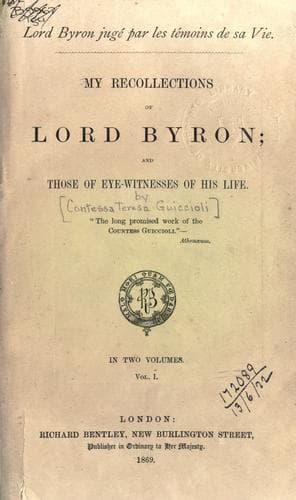
My Recollections of Lord ByronGuiccioli, Teresa, contessa di
General
My Recollections of Lord Byron
Guiccioli, Teresa, contessa di
Byron, George Gordon Byron, Baron, 1788-1824; Poets, English -- 19th century -- Biography
Harold, then, has ceased to be the weary _blase_ pilgrim of twenty-one,
who in the first canto remains unmoved in presence of the attractions of
Florence the beautiful, who inspired the poet with such different
sentiments that in the midst even of a storm which threatens to swallow
him up he actually finds strength enough to express his sentiments of
real love for the lovely absent one--of a love, indeed, which is
evidently returned. His heart, like the poet's, now beats with a pure
love, and causes him to chant the absence of his friend in the most
beautiful strain. Where is the old Harold? It would seem as if the poet,
tired of a companion so disagreeable and so opposed to his tastes, and
wishing to get rid of him but not knowing how, had first changed and
moulded him to his own likeness by giving him his own sentiments, his
own great heart, his own pains, his own affections, and, not finding the
change natural, had dismissed him altogether. And so it appears, for
after the fifty-fifth stanza of the third canto, Childe Harold
disappears forever. Thus at the beginning of the fourth canto, which was
published a year after, under the auspices of an Italian sky, the reader
finds himself in the presence of the poet only. He meets in him a great
and generous soul, but the victim of the most odious and unmerited
persecution, who takes his revenge in forgiving the wrongs which are
done to him, and who reserves all his energies to consecrate them to the
love of that which is lovable, to the admiration of that which calls for
it, and who at twenty-nine years of age is imbued with Christian and
philosophical qualities, which his wearied hero could never have
possessed.
Why then again have identified Byron with Childe Harold? For what
reason? It strikes us, that the simplest notions of fairness require us
at least to take into account the words of the author himself, and to
listen to the protestations of a man who despised unmerited praise more
than unjust reproof.
"A fictitious character," says Byron, "is introduced for the sake of
giving some connection to the piece....
"It had been easy to varnish over his faults, to make him do more and
express less, but he never was intended as an example, further than to
show that early perversion of mind and morals leads to satiety of past
pleasures and disappointment in new ones, and that even the beauties of
nature and the stimulus of travel are lost on a soul so constituted, or
rather misdirected.
"It has been suggested to me by friends, on whose opinions I set a high
value, that in this fictitious character, 'Childe Harold,' I may incur
the suspicion of having intended some real personage: this I beg leave
once for all to disclaim--Harold is the child of imagination, for the
purpose I have stated. In some very trivial particulars, and those
merely local, there might be grounds for such a notion: but in the main
points, I should hope, none whatever."
Public-domain text, read in full here on John Shaqi.
Reviews
Reviews
No reviews yet
Be the first to share your thoughts on this work.
Join the Discussion
Join the discussion
Sign in to leave a comment or review.
Sign InorCreate an account