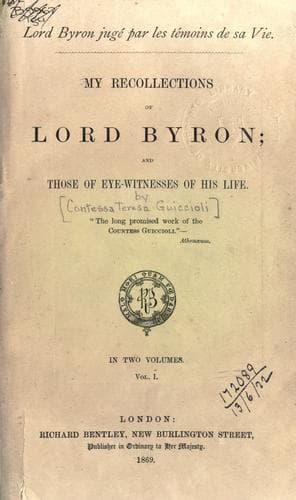
My Recollections of Lord ByronGuiccioli, Teresa, contessa di
General
My Recollections of Lord Byron
Guiccioli, Teresa, contessa di
Byron, George Gordon Byron, Baron, 1788-1824; Poets, English -- 19th century -- Biography
Why then identify Lord Byron with a personage he himself disowns as his
prototype, both in his notes, in his preface, in his conversations; and
who is proved by facts, by the poem itself, and by the poet's logical
and moral reasoning, to be entirely different from his creation? It is
true that Byron conceived the unfortunate idea of surrounding his hero
by several incidents in his own existence, to place him in the social
circle to which he himself belonged, and to give him a mother and a
sister, a disappointed love, a Newstead Abbey like his own, and to make
him travel where he had travelled and experience the same adventures.
That is true, and such an act of imprudence can only be explained, by
the confidence on which he relied that the identification could never
have been thought of. At twenty-one conscience speaks louder than
experience. But if we can justify the accusation of his having been
imprudent, can we justify his having been calumniated?
Eight years after the publication of the second canto, Byron wrote the
third; and here the pilgrim occasionally appears, but so changed that he
seems to have been merged into the poet, and to form with him one person
only. Childe Harold's sorrows are those of Lord Byron, but there no
longer exists any trace of misanthropy or of satiety. His heart already
beats with that of the poet for chaste and devoted affections, for all
the most amiable, the most noble, and the most sublime of sentiments. He
loves the flowers, the smiling and glorious, the charming and sublime
aspect of nature.
"Yet not insensible to all which here
Awoke the jocund birds to early song
In glens which might have made even exile dear;
Though on his brow were graven lines austere,
And tranquil sternness, which had ta'en the place
Of feelings fiercer far but less severe,
Joy was not always absent from his face,
But o'er it in such scenes would steal with transient trace."
No longer, then, is satiety depicted upon the pilgrim's brow, but "lines
austere;" and the poet seems so desirous of proving to us that Harold is
metamorphosed, that when he expresses sentiments full of sympathy,
humanity, and goodness, his horror for war and his dislike for the
beauties of the Rhine, because--
"A thousand battles have assail'd thy banks,"
he takes care to add--
"Thus Harold inly said"....
Public-domain text, read in full here on John Shaqi.
Reviews
Reviews
No reviews yet
Be the first to share your thoughts on this work.
Join the Discussion
Join the discussion
Sign in to leave a comment or review.
Sign InorCreate an account