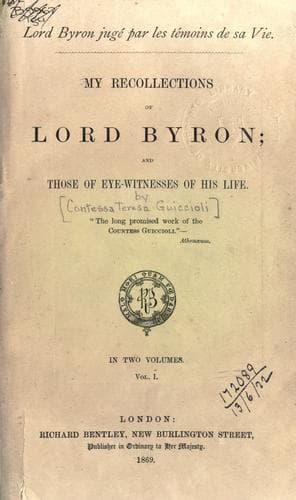
My Recollections of Lord ByronGuiccioli, Teresa, contessa di
General
My Recollections of Lord Byron
Guiccioli, Teresa, contessa di
Byron, George Gordon Byron, Baron, 1788-1824; Poets, English -- 19th century -- Biography
In Shelley's heart the dominant wish was to see society entirely
reorganized. The sight of human miseries and infirmities distressed him
to the greatest degree; but, too modest himself to believe that he was
called upon to take the initiative, and inaugurate a new era of good
government and fresh laws for the benefit of humanity, he would have
been pleased to see such a genius as Byron take the initiative in this
undertaking. "He can be the regenerator of his country," wrote Shelley,
speaking of Byron, in 1818, at Venice.
Shelley therefore did his best to influence Lord Byron. But the latter
hated discussions: he could not bear entering into philosophical
speculation at times when his soul craved the consolations of friendship
and his mind a little rest. He was quite insensible to reasonings, which
often appear sublime because they are clothed in words incomprehensible
to those who have not sought to understand their meaning. But he made an
exception in favor of Shelley. He knew that he could not shake his faith
in a doctrine founded upon illusions, by his incredulity: but he
listened to him with pleasure, not only on account of Shelley's good
faith and sincerity of meaning, but also because he argued upon false
data with such talent and originality that he was both interested and
amused. But with all his great and noble qualities was it to be
expected that Lord Byron would fall into the doctrines proffered by
pantheists? Doctrines rejected by reason, which wound the heart, are
opposed to the most imperative necessities of our nature, and only bring
desolation to our minds.
Lord Byron had examined every kind and species of philosophy by the
light of common sense, and by the instinct of his genius: the result had
been to make him compassionate toward the vain weaknesses of the human
understanding, and to convince him that all systems which have
hypothesis as groundwork are illusions, and consequently likely to
perish with their authors.
Pantheism in particular was odious to him, and he esteemed it to be the
greatest of absurdities. He made no difference between the Pantheism
"absolute," which mixes up that which is infinite with that which is
finite, and that which struggles in vain to keep clear of Atheism.
Public-domain text, read in full here on John Shaqi.
Reviews
Reviews
No reviews yet
Be the first to share your thoughts on this work.
Elsewhere in the archive
Join the Discussion
Join the discussion
Sign in to leave a comment or review.
Sign InorCreate an account