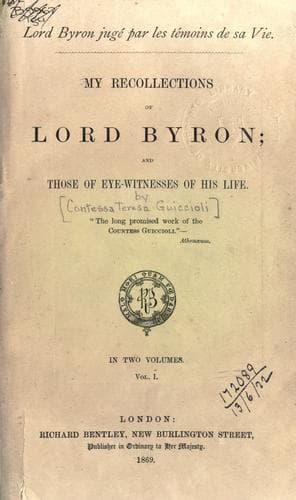
My Recollections of Lord ByronGuiccioli, Teresa, contessa di
General
My Recollections of Lord Byron
Guiccioli, Teresa, contessa di
Byron, George Gordon Byron, Baron, 1788-1824; Poets, English -- 19th century -- Biography
In an age like ours, when the common tendency is of a materialistic
character, such as almost to defy the power of man, mysticism has little
or no _locus standi_. Shelley's opinions, on account of their appearance
of spiritualism, were most likely of any to interest Byron; but, founded
as they are upon fancy, could they please him? Could he possibly consent
to lose his individuality, deny his own freedom of will, all
responsibility of action, and hence all his privileges, his future
existence, and all principles of morality? Could he possibly admit that
the doctrine which prescribed these sacrifices was better than any
other? Even with the best intentions, could any of the essential, moral,
and holy principles of nature be introduced into such a system? Byron
could not but condemn it, and he attributed all Shelley's views to the
aberrations of a mind which is happier when it dreams than when it
denies.
Here, then, was the cause of his being inaccessible to Shelley's
arguments. He used sometimes to exclaim, "Why Shelley appears to me to
be mad with his metaphysics." This he one day repeated to Count Gamba at
Pisa, as Shelley walked out and he came in. "We have been discussing
metaphysics," said he: "what trash in all these systems! Say what they
will, mystery for mystery, I still find that of the Creation the most
reasonable of any."
He made no disguise of the difficulties which he found in admitting the
doctrine of a God, Creator of the world, and entirely distinct from it;
but he added, "I prefer even that mystery to the contradictions by which
other systems endeavor to replace it." He certainly found that in the
mystery of Creation there existed the proof of the weakness of our
minds, but he declared that pantheism had to explain absurdities far too
evident for a logical mind to adopt its tenets. "They find," said he,
"that reason is more easily satisfied with a system of unity like
theirs, in which all is derived from one principle only: may be, but
what do we ask of truth? why all our never-ceasing efforts in its
pursuit? Is it merely that we may exercise the mind, and make truth the
toy of our imagination? Impossible. At any rate it would be a secret to
which, as yet, God has not given us any clue. But in doing this, in
constantly placing the phenomena of creation before us without their
causes or without ever explaining them, and at the same time instilling
into our souls an insatiable thirst for truth, the Almighty has placed
within us a voice which at times reminds us that He is preparing some
surprise for us; and we trust that that surprise may be a happy one."
Public-domain text, read in full here on John Shaqi.
Reviews
Reviews
No reviews yet
Be the first to share your thoughts on this work.
Elsewhere in the archive
Join the Discussion
Join the discussion
Sign in to leave a comment or review.
Sign InorCreate an account