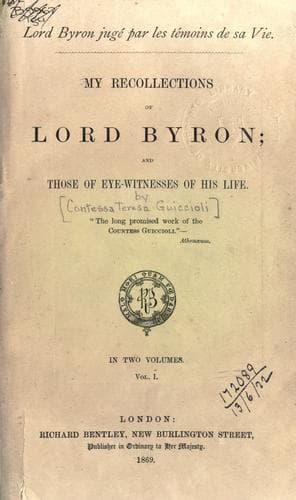
My Recollections of Lord ByronGuiccioli, Teresa, contessa di
General
My Recollections of Lord Byron
Guiccioli, Teresa, contessa di
Byron, George Gordon Byron, Baron, 1788-1824; Poets, English -- 19th century -- Biography
"Of the immortality of the soul, it appears to me that there can be
little doubt, if we attend to the action of the mind for a moment: it is
in perpetual activity. I used to doubt it, but reflection has taught me
better. The stoics Epictetus and Aurelius call the present state 'a soul
which draws a carcass'--a heavy chain, to be sure, but all chains, being
material, may be shaken off. How far our future life will be individual,
or, rather, how far it will at all resemble our present existence, is
another question; but that the mind is eternal, seems as probable as
that the body is not so. Of course, I here venture upon the question
without recurring to revelation, which, however, is at least as rational
a solution of it as any other. A material resurrection seems strange and
even absurd, except for purposes of punishment: and all punishment which
is to revenge, rather than correct, must be morally wrong: and when the
world is at an end, what moral or warning purpose can eternal tortures
answer? Human passions have probably disfigured the Divine doctrines
here; but the whole thing is inscrutable."
And again:--
"I have often been inclined to materialism in philosophy; but could
never bear its introduction into Christianity, which appears to me
essentially founded upon the soul. For this reason, Priestley's
'Christian Materialism' always struck me as deadly. Believe the
resurrection of the body, if you will, but not without a soul. The deuce
is in it, if after having had a soul (as, surely, the mind, or whatever
you call it, is) in this world, we must part with it in the next, even
for an immortal materiality; and I own my partiality for spirit."
It has already been seen that, in his early youth, he was intimately
convinced of the immortality of his soul, by the fact of the existence
of his conscience. But it is equally proved that, as his soul became
more perfect, and rose more and more toward all that is great and
virtuous, his conviction of the immortality of the soul became still
more certain.
The beautiful words which he addressed to Mr. Parry, a few hours before
his agony, confirm our assertions:--
"Eternity and space are before me; but on this subject, thank God, I am
happy and at ease. The thought of living eternally, of again reviving,
is a great pleasure. Christianity is the purest and most liberal
religion in the world; but the numerous teachers who are continually
worrying mankind with their denunciations and their doctrines, are the
greatest enemies of religion. I have read, with more attention than half
of them, the Book of Christianity, and I admire the liberal and truly
charitable principles which Christ has laid down. There are questions
connected with this subject, which none but Almighty God can solve. Time
and space, who can conceive? None but God: on Him I rely."
Public-domain text, read in full here on John Shaqi.
Reviews
Reviews
No reviews yet
Be the first to share your thoughts on this work.
Elsewhere in the archive
Join the Discussion
Join the discussion
Sign in to leave a comment or review.
Sign InorCreate an account