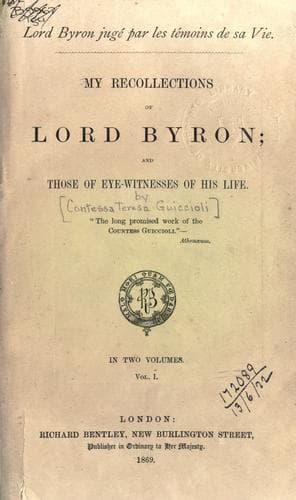
My Recollections of Lord ByronGuiccioli, Teresa, contessa di
General
My Recollections of Lord Byron
Guiccioli, Teresa, contessa di
Byron, George Gordon Byron, Baron, 1788-1824; Poets, English -- 19th century -- Biography
If he neither questioned the existence of God nor the spirituality and
immortality of the soul, did he question our liberty of thought, and
hence our moral responsibility?
To put such a question, is to misunderstand Byron completely. Who, more
than Byron, ever believed in our right of judgment, and proclaimed that
right more strenuously than he has, in prose and in verse? Let any one
who has read "Manfred," say whether a poet ever developed such Christian
and philosophical views with greater energy and power.
Did Lord Byron really question, in his poems, the infinite goodness of
God, as he has been accused of doing? Did his doubts and perplexities of
mind, caused by the terrible knowledge of the existence of evil, ever go
beyond the limits of the doubts which beset the minds of intellectual
men, when the light of faith fails to aid them in their philosophical
researches after truth?
When he published his drama, "Cain, a Mystery," he was attacked by
enemies in the most violent manner. They selected the arguments put into
the mouth of Lucifer, and their influence upon Cain, to prove that this
biblical poem was a blasphemous composition, and that its author was
consequently deserving of being outlawed, as having attempted to
question the supreme wisdom of God. But most certainly Lucifer speaks in
the poem as Lucifer should speak, unless, indeed, the Evil Spirit ought
to speak as a theologian, and the first assassin as a meek orthodox
Christian? Byron gave them each the language logically most suited to
their respective characters, as Milton did, without, however, incurring
the accusation of impiety. It was argued that Byron ought, at least, to
have introduced some one charged with the defense of the right
doctrines. But was not the drama entitled a Mystery, and was not the
title to be justified, as it were? Could he have done otherwise, even if
he had wished it ever so much? What could Adam, or even God's angel, do
better than remain silent in presence of the mental agony of Cain, and
only advise his bowing to the incomprehensibility of the mystery? Again,
if discussion was fruitful of results with Abel, must it be the same
with Cain? Was Lord Byron to turn both these personages into
theologians, ready to discuss any and every metaphysical question, and
to explain the origin and effects of evil? Had they done so, it is not
very likely they would have succeeded in persuading Cain of the solidity
of their argument, or in dispelling the clouds which obscured his mind,
and both calm his despair and satisfy so inquisitive a nature,
influenced and mastered, as it was, by evil passions. If Lord Byron
thought he could explain the existence of evil, he would not have
entitled his poem "a Mystery." But, above all, Lord Byron did not wish
to outstep the limits of reason to prove still more how powerless is
reason, alone and unaided, in its endeavors to conciliate contradictory
attributes. The drama was called a Mystery, and Byron wished it to
Public-domain text, read in full here on John Shaqi.
Reviews
Reviews
No reviews yet
Be the first to share your thoughts on this work.
Elsewhere in the archive
Join the Discussion
Join the discussion
Sign in to leave a comment or review.
Sign InorCreate an account