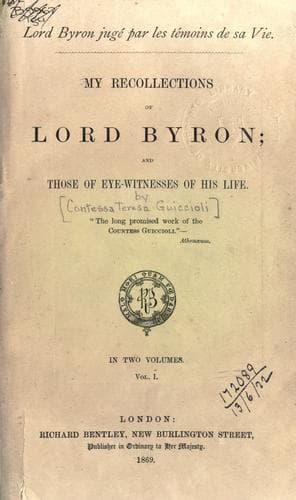
My Recollections of Lord ByronGuiccioli, Teresa, contessa di
General
My Recollections of Lord Byron
Guiccioli, Teresa, contessa di
Byron, George Gordon Byron, Baron, 1788-1824; Poets, English -- 19th century -- Biography
remain such.
Were some of his biographers right in asserting that he had adopted
Cuvier's system? But Cuvier never denied the existence of the Creator,
as Moore seems to believe. On the contrary, he endeavored to show, even
more forcibly, the admirable work of the Creation, in order to bring out
still more in relief the perfection of its Creator.
In the end, however, Byron ceased to think the existence of evil to be
so great an injustice to the infinite goodness of God, and expressed in
his memorandum the opinion "that history and experience show that good
and evil are counterbalanced on earth."
"Were I to begin life again," he said, in the same memorandum, "I don't
think I would change any thing in mine." A proof that, without
understanding why or wherefore, he felt our life on earth to be but the
beginning of one which is to be continued in another sphere, under the
rule of Him whose gentle hand can be traced in all things created. For
the same reason he was reconciled to the injustice of mankind, believing
this life to be a trial, and bearing it with noble courage and
fortitude. This mental resignation, however, did not prevent his
suffering bitterly in a moral sense. All pleasure became a pain to him
at the sight of the sufferings of others. He declared on one occasion,
at Cephalonia, that if every body was to be damned, and he alone to be
saved, he would prefer being damned with the rest. This excess of
generosity may have appeared eccentric, but can scarcely seem too
exaggerated to those who knew him. Certain it is, that to witness the
sufferings of others with resignation, appeared to him to be egotism,
and to evince a coldheartedness, which would have been unpardonable in
his eyes. Sometimes even the energy of his writings, dictated, as they
were, by his great generosity of heart, appeared as the revolt of a
noble nature against the miseries of humanity.
In such a frame of mind was he when he wrote "Cain," at Ravenna, in the
midst of people who were for the most part unjustly proscribed, and in
the midst of sufferings which he always tried to alleviate.
Did he deserve the appellation of skeptic, because he despised that vain
philosophy which believes it can explain all things, even God's nature
itself, by the sole force of reason? or because, while respecting the
dogmas proclaimed by our reason and our conscience, he preferred to
follow the principles of a philosophy that argues with diffidence, and
humbly owns its inability to explain all things, and which caused him to
exclaim in "Don Juan"--
"For me, I know naught; nothing I deny,
Admit, reject, contemn: and what know you,
Except, perhaps, that you were born to die?"
Public-domain text, read in full here on John Shaqi.
Reviews
Reviews
No reviews yet
Be the first to share your thoughts on this work.
Elsewhere in the archive
Join the Discussion
Join the discussion
Sign in to leave a comment or review.
Sign InorCreate an account