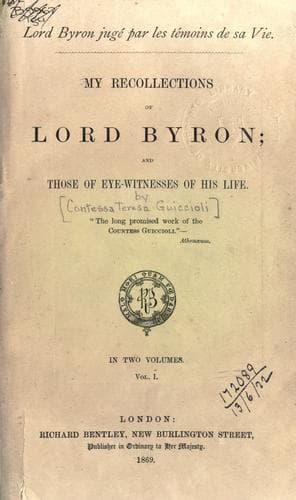
My Recollections of Lord ByronGuiccioli, Teresa, contessa di
General
My Recollections of Lord Byron
Guiccioli, Teresa, contessa di
Byron, George Gordon Byron, Baron, 1788-1824; Poets, English -- 19th century -- Biography
But to whom were these lines addressed? To those metaphysicians, of
course, whom he would also have denominated "men who know nothing, but
who, among the truths which they ignore, ignore their own ignorance
most,"--to those arrogant minds who wish to fathom even the ways which
God has kept back from us, and who, in seeking to know the wherefore of
all things in creation, are forced to give the name of explanation to
mere comparisons.
Byron says, in "Don Juan,"--
"Explain me your explanation."
He addressed himself finally, to all hypocrites and intolerant men;
Byron has been called a skeptic, notwithstanding.
That a sincere and orthodox Catholic, who holds that the negation of a
dogma constitutes skepticism, should have called Byron a skeptic because
he questioned the doctrine of eternal punishment, is not to be wondered
at; but what is matter of astonishment is, that the reproach was
addressed to him by the writer of "Faust," and by the writer of
"Elvire," and the "Meditations." Yet it is so; and if this psychological
problem is not yet solved, let others do it,--we can not.
To sum up, we may declare, from what we have said, that as regards Lord
Byron there has been a confusion of words, and that his skepticism has
merely been a natural and inevitable situation in which certain minds
who, as it were, are the victims of their own contradictory thoughts,
are placed, notwithstanding their wish to believe. Faith, being a part
of poetical feeling, could not but form a part likewise of Byron's
nature, but there existed also in him a great tendency to weigh the
merits of the opinions of others, and consequently the desire not to
arrive too hastily at conclusions.
This combination of instinctive faith and a philosophical mind could not
produce in him the belief in those things which did not appear to him to
have been first submitted to the test of argument, and proved to be just
by the convictions resulting from the test of reasoning to which they
had been subjected. It produced, on the contrary, a species of expectant
doubt, a state of mind awaiting some decisive explanation, to reject
error and embrace the truth. His skepticism, therefore, may be said to
have been the result of thought, not of passion.
In religion, however, it must be allowed that his skepticism never went
so far as to cause him to deny its fundamental doctrines. These he
proclaimed from heartfelt convictions, and his modest, humble, and manly
skepticism may be said to have been that of great minds, and his
failings, also, theirs. Is a day said to be stormy because a few clouds
have obscured the rays of the sun?
Public-domain text, read in full here on John Shaqi.
Reviews
Reviews
No reviews yet
Be the first to share your thoughts on this work.
Elsewhere in the archive
Join the Discussion
Join the discussion
Sign in to leave a comment or review.
Sign InorCreate an account