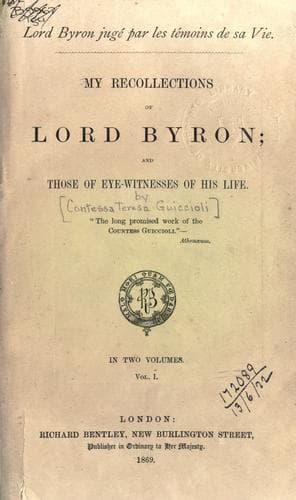
My Recollections of Lord ByronGuiccioli, Teresa, contessa di
General
My Recollections of Lord Byron
Guiccioli, Teresa, contessa di
Byron, George Gordon Byron, Baron, 1788-1824; Poets, English -- 19th century -- Biography
Is it necessary to say any thing about what he doubted? In showing what
he believed, the exception will be found unnecessary. He believed in a
Creator, in a spiritual and consequently immortal soul, but which God
can reduce to nothing, as He created it out of nothing. He believed in
liberty of thought, in our responsibility, our privileges, our duties,
and especially in the obligation of practicing the great precept which
constitutes Christianity; namely, that of charity and devotion toward
our neighbor, even to the sacrifice of our existence for his sake. He
believed in every virtue, but his experience forbade his according faith
to appearances, and trusting in fine phrases. He often found it wise and
prudent to scrutinize the idol he was called upon to worship, but when
once that idol had borne the test of scrutiny no worship was so sincere.
"Was he orthodox?" will again be asked. To such a question it may be
justly answered, that if he did not entertain for all the doctrines
revealed by the Scriptures that faith which he was called upon to
possess, it was not for want of desiring so powerful an auxiliary to his
reason. He felt that, however strong reason might be, it always retains
a little wavering and anxious character; and, though essentially
religious at heart, he could not master that blind faith required in
matters which baffle the efforts of reason to prove their truth
logically and definitively. This is to be accounted for by the conflict
of his conscience and his philosophical turn of mind. Conviction, for
him, was a difficult thing to attain. Hence for him the difficulty of
saying "I believe," and hence the accusation of skepticism to which he
became liable. He wanted proofs of a decisive character, and his doubts
belonged to that school which made Bacon confess that a philosopher who
can doubt, knows more than all the wise men together. Byron would never
have contested absolutely the truth of any mystery, but have merely
stated that, as long as the testimonies of its truth were hidden in
obscurity, such a mystery must be liable to be questioned. He was wont
to add, however, that the mysteries of religion did not appear to him
less comprehensible than those of science and of reason.
As for miracles, how could he think them absurd and impossible, since he
admitted the omnipotence of God? His mind was far too just not to
understand that miracles surround us, even from the first origin of our
race. He often asked himself, whether the first man could ever have been
created a child? "Reason," says a great Christian philosopher, "does not
require the aid of the Book of Genesis to believe in that miracle."
One evening at Pisa, in the drawing-room of the Countess G----, where
Byron was wont to spend all his evenings, a great discussion arose
respecting a certain miracle which was said to have taken place at
Lucca.
Public-domain text, read in full here on John Shaqi.
Reviews
Reviews
No reviews yet
Be the first to share your thoughts on this work.
Elsewhere in the archive
Join the Discussion
Join the discussion
Sign in to leave a comment or review.
Sign InorCreate an account