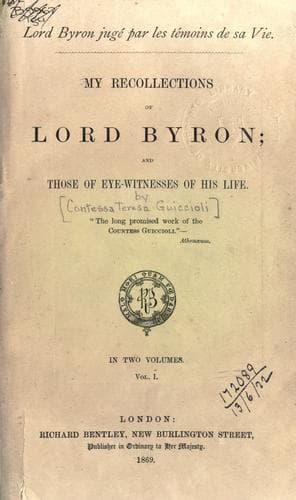
My Recollections of Lord ByronGuiccioli, Teresa, contessa di
General
My Recollections of Lord Byron
Guiccioli, Teresa, contessa di
Byron, George Gordon Byron, Baron, 1788-1824; Poets, English -- 19th century -- Biography
The miracle had been accompanied by several rather ludicrous
circumstances, and of course laughter was not spared. Shelley, who never
lost sight of his philosopher, treated miracles as deplorable
superstitions. Lord Byron laughed at the absurdity of the history told,
without any malice however. Madame G---- alone did not laugh. "Do you,
then, believe in that miracle?" asked Byron. "I do not say I exactly
believe in that miracle," she replied; "but I believe in miracles, since
I believe in God and in His omnipotence; nor could I believe that God
can be deprived of His liberty, when I feel that I have mine. Were I no
longer to believe in miracles, it seems to me I should no longer believe
in God, and that I should lose my faith."
Lord Byron stopped joking, and said--
"Well, after all, the philosophy of common sense is the truest and the
best."
The conversation continued, in the jesting tone in which it had begun,
and M. M----, an _esprit fort_, went so far as to condemn the
supernatural in the name of the general and permanent laws which govern
nature, and to look upon miracles as the legends of a by-gone age, and
as errors which affect the ignorant. From what had gone before, he
probably fancied that Byron was going to join issue with him. But there
was often a wide gulf between the intimate thoughts of Byron and his
expressions of them.
"We allow ourselves too often," he said, "to give way to a jocular mood,
and to laugh at everything, probably because God has granted us this
faculty to compensate for the difficulty which we find in believing, in
the same manner as playthings are given to children. But I really do not
see why God should be obliged to preserve in the universe the same
order which He once established. To whom did He promise that He would
never change it, either wholly or in part? Who knows whether some day He
will not give the moon an oval or a square shape instead of a round
one?"
This he said smiling, but added immediately after, in a serious tone:--
"Those who believe in a God, Creator of the universe, can not refuse
their belief in the possibility of miracles, for they behold in God the
first of all miracles."
Finally, Lord Byron determined himself the limits of what he deemed his
necessary belief; and remained throughout life a stanch supporter of
those opinions, but he never ceased to evince a tendency to steer clear
of intolerance, which according to him only brought one back to total
unbelief.
Let us not omit to add that, as he grew older, he saw better the
arrogant weakness of those who screen themselves under the cover of
science, and recognized more clearly each day the hand of the Creator in
the works of nature.
"Did Lord Byron pray?" is another objection which will be made.
Public-domain text, read in full here on John Shaqi.
Reviews
Reviews
No reviews yet
Be the first to share your thoughts on this work.
Elsewhere in the archive
Join the Discussion
Join the discussion
Sign in to leave a comment or review.
Sign InorCreate an account