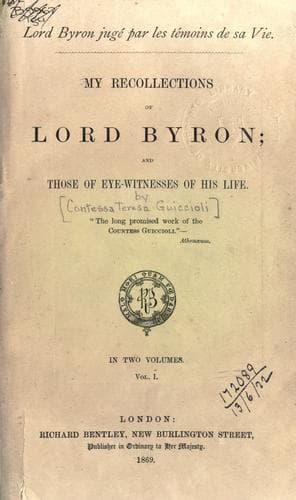
My Recollections of Lord ByronGuiccioli, Teresa, contessa di
General
My Recollections of Lord Byron
Guiccioli, Teresa, contessa di
Byron, George Gordon Byron, Baron, 1788-1824; Poets, English -- 19th century -- Biography
We have already seen what he thought of prayer; we have shown that his
poems often took the form of a prayer, and we have read with admiration
various passages containing some most sublime lines which completely
answer those who accused him of want of religion, while they exhibit the
expansion of his soul toward God.
We also know with what feelings of respect he approached places devoted
to a religious life, and what charms he found in the ceremonies of the
Church. All this is proof enough, it would seem; but, in any case, we
must add that if his prayers were not those advised by Kennedy, they
were at least the prayers of a great soul which soars upward to bow
before its Creator. "Outward ceremonies," says Fenelon, "are only tokens
of that essential point, the religion of the soul, and Byron's prayer
was rather a thanksgiving than a request."--"In the eyes of God," says
some one, "a good action is worth more than a prayer."
Such was his mode of communing with God even in his early youth, but
especially in his last moments, which were so sublime. Can one doubt,
that at that solemn moment his greatest desire was to be allowed to
live? He had still to reap all the fruits of his sacrifices. His harvest
was only just beginning to ripen. By dint of heroism, he was at last
becoming known. He was young, scarcely thirty-six years of age,
handsome, rich. Rank and genius were his. He was beloved by many,
notwithstanding a host of jealous rivals; and yet, on the point of
losing all these advantages, what was his prayer? Was it egotistical or
presumptuous? was it to solicit a miracle in his favor? No, his last
words were those of noble resignation. "Let Thy holy will, my God, be
done, and not mine!" and then absorbed, as it were, in the infinity of
God's goodness, and, confiding entirely in God's mercy, he begged that
he might be left alone to sleep quietly and peacefully into eternity. On
the very day which brought to us the hope of our immortality, he would
awake in the bosom of God.
FOOTNOTES:
[Footnote 17: Sympathy.]
[Footnote 18: The Rev. Mr. Hodgson and the Rev. Mr. Harness.]
[Footnote 19: Article on his Life in Italy and at Pisa.]
CHAPTER V.
CHILDHOOD AND YOUTH OF LORD BYRON.
All Byron's biographers (at least all those who knew him) have borne
testimony to his great goodness, but they have not dwelt sufficiently
upon this principal feature in his character. Biographers generally wish
to produce an effect. But goodness is not a sufficiently noticeable
quality to be dilated upon; it would not repay ambition or curiosity. It
is a quality mostly attributed to the saints, and a biographer prefers
dilating upon the defects of his hero, upon some adventure or
scandal--means by which it is easy, with a spark of cleverness, to make
a monster of a saint: for, alas! the most rooted convictions are often
sacrificed for the sake of amusing a reader who is difficult to please,
and of satisfying an editor.
Public-domain text, read in full here on John Shaqi.
Reviews
Reviews
No reviews yet
Be the first to share your thoughts on this work.
Elsewhere in the archive
Join the Discussion
Join the discussion
Sign in to leave a comment or review.
Sign InorCreate an account