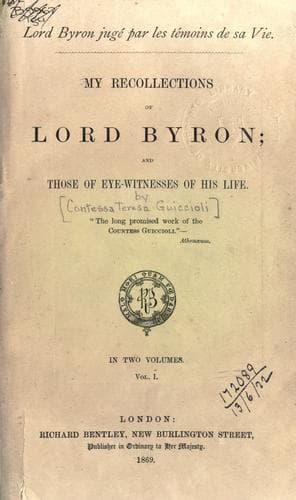
My Recollections of Lord ByronGuiccioli, Teresa, contessa di
General
My Recollections of Lord Byron
Guiccioli, Teresa, contessa di
Byron, George Gordon Byron, Baron, 1788-1824; Poets, English -- 19th century -- Biography
It was this extraordinary union of energy and sensitiveness in Byron
which was to determine the choice of subjects. No doubt the desire to
produce an effect had a part in the selection, especially at the dawn of
his genius; and this would seem evident in the picture of satiated
pleasure as represented by Childe Harold, and in the strange nature of
Manfred. But this is only a portion of the reality. His principal
qualities were the real arbiters in the selection of subjects which he
made. God has not given to us all the same voice. The largest trees--the
oaks--require the help of storms to make their voices heard, while the
reed only needs the help of the summer breeze.
Byron's attention was ever directed to what was uncommon, either in
nature or in the human heart; either in good or in evil, either in the
ordinary course of things or beyond its limits. To the study of placid
nature he preferred that of that soul which, though less well regulated,
yet rises superior to fortune by its energy and will.
The spark which lit up his genius could not live in that goodness which
constituted the groundwork of his nature, but in passion, called forth
by the sight of great misfortunes, great faults, great crimes, in fact,
by the sight of all which attracted or repelled him, which was most in
harmony with his energetic character, or at greatest variance with his
sensitive nature. One of the motives which actuated his mind was
sympathy--the other, antipathy; which exercised over him the same kind
of fascination which the bird feels whom the serpent's glance has
fascinated, or like the unaccountable impulse which causes a man to
throw himself down the precipice on the verge of which he stands.
The various aspects of nature exercised a similar influence over him.
With his exquisite sense of their beauties, Byron no doubt often
described the enchanting climates in the midst of which he placed the
action of his poems; but his pen had always a manly action, with a
mixture of grace and vigor in it quite inimitable. His descriptions,
however, always appeared to be secondary objects in his mind, and rather
constituted the frames which encircled the man whom he wished to depict.
One would say that the soft beauties of a landscape and the playful
zephyrs which caress the crests of little waves were too effeminate
subjects for him to dwell upon. His preferences evidently point to the
savage side of nature, to the struggles between physical forces, to the
sublimities of the tempest, and almost, I would say, to a certain
disorganization of nature; provided, of course, all is restored to order
the moment such a disorganization threatens the existence of beauty in
art or in the moral world.
Public-domain text, read in full here on John Shaqi.
Reviews
Reviews
No reviews yet
Be the first to share your thoughts on this work.
Join the Discussion
Join the discussion
Sign in to leave a comment or review.
Sign InorCreate an account